When a small amount of iodine is added to a mixture of chlorine and methane, it prevents chlorination from occurring. Therefore, iodine is a free-radical inhibitor for this reaction. Calculate ΔH° values for the possible reactions of iodine with species present in the chlorination of methane, and use these values to explain why iodine inhibits the reaction. (The I―Cl bond-dissociation enthalpy is 211 kJ/mol or 50 kcal/mol.)
Verified step by step guidance
1
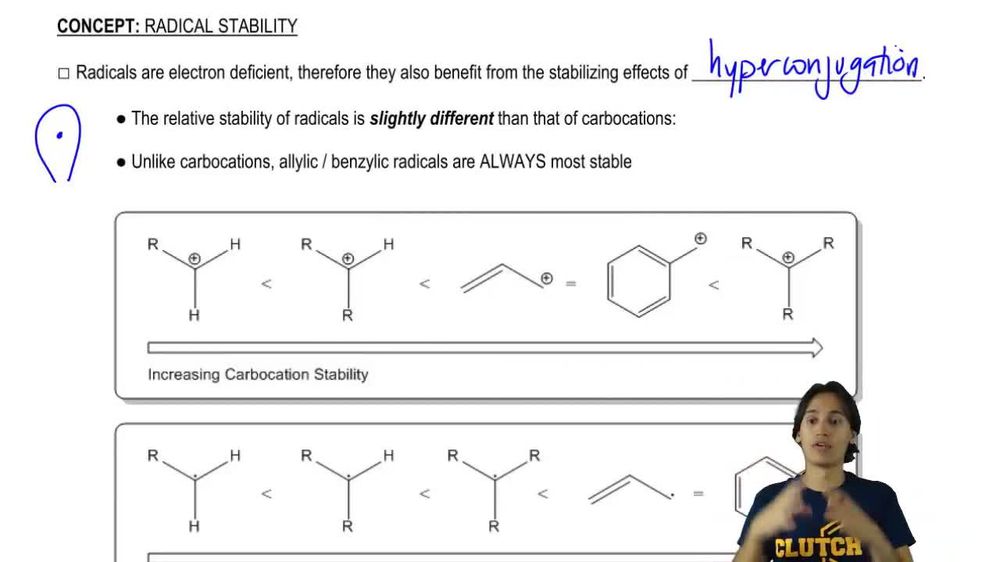
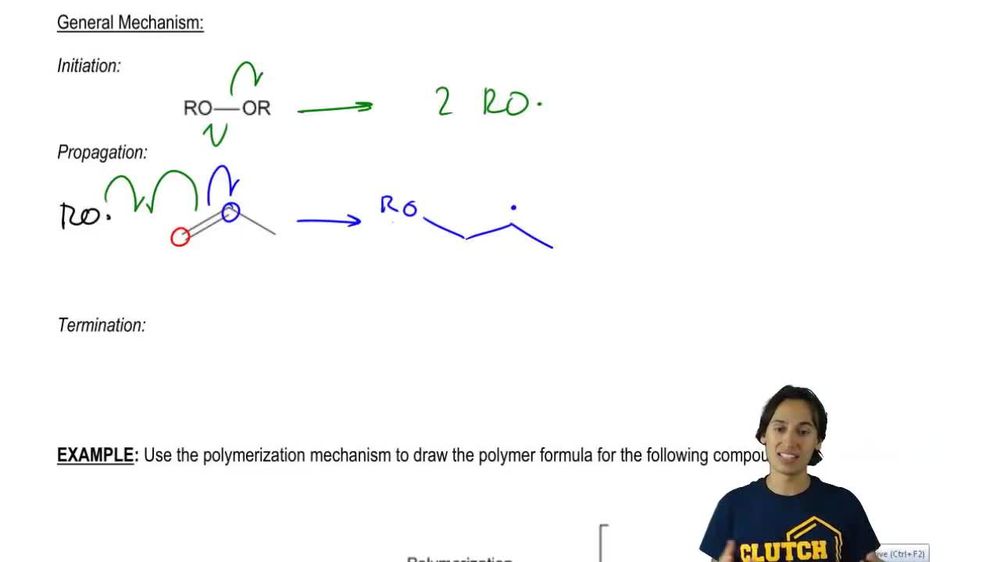
Step 1: Understand the context of the problem. The chlorination of methane is a free-radical chain reaction that involves the formation of reactive intermediates such as chlorine radicals (Cl•) and methyl radicals (CH3•). Iodine acts as a free-radical inhibitor by reacting with these radicals, preventing the propagation of the chain reaction.
Step 2: Identify the possible reactions of iodine with the species involved in the chlorination of methane. These reactions include: (1) Iodine reacting with chlorine radicals (Cl•) to form I―Cl bonds, and (2) Iodine reacting with methyl radicals (CH3•) to form I―CH3 bonds.
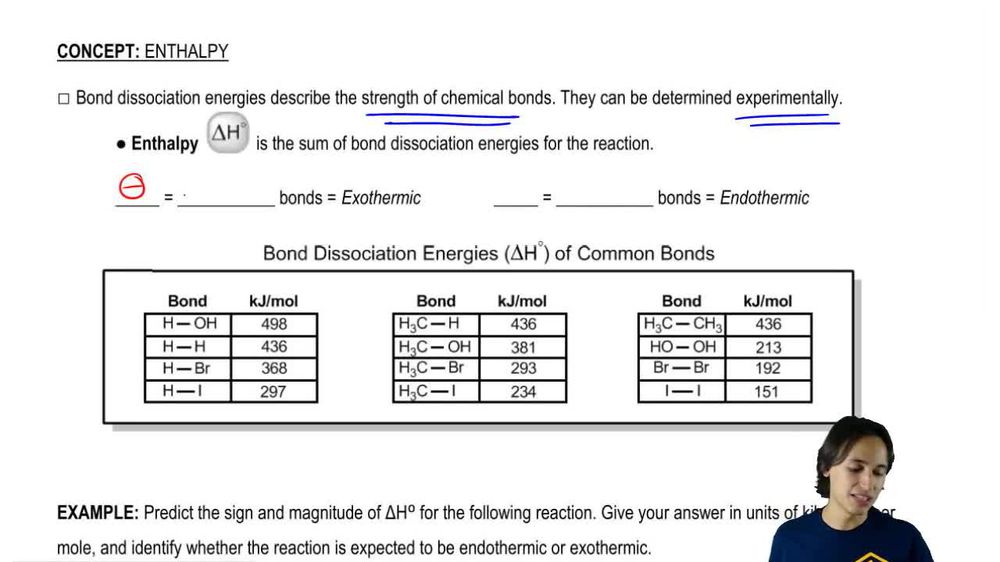
Step 3: Use the bond-dissociation enthalpy (BDE) values to calculate ΔH° for each reaction. For example, the reaction of iodine with Cl• involves breaking the I2 bond (BDE = 151 kJ/mol or 36 kcal/mol) and forming the I―Cl bond (BDE = 211 kJ/mol or 50 kcal/mol). The ΔH° can be calculated using the formula: ΔH° = Σ(BDE of bonds broken) - Σ(BDE of bonds formed).
Step 4: Perform similar calculations for the reaction of iodine with CH3•. This involves breaking the I2 bond and forming the I―CH3 bond. You would need the BDE of the I―CH3 bond (typically provided in a reference table or problem statement) to complete this calculation.
Step 5: Analyze the ΔH° values obtained. If the reactions of iodine with radicals are highly exothermic (negative ΔH°), this indicates that iodine effectively stabilizes the radicals by forming strong bonds, thereby inhibiting the free-radical chain reaction. Discuss how this thermodynamic stability explains iodine's role as a free-radical inhibitor in the chlorination of methane.
Verified video answer for a similar problem:
This video solution was recommended by our tutors as helpful for the problem above
Video duration:
11m
Play a video:
0 Comments
Key Concepts
Here are the essential concepts you must grasp in order to answer the question correctly.
Free Radical Mechanism
The free radical mechanism involves the formation of reactive species called free radicals, which are atoms or molecules with unpaired electrons. In the chlorination of methane, chlorine radicals are generated that can abstract hydrogen atoms from methane, leading to chlorinated products. Understanding this mechanism is crucial to grasp how iodine, by forming its own radicals, can interfere with the chlorination process.
Bond dissociation enthalpy is the energy required to break a specific bond in a molecule, resulting in the formation of free radicals. In this context, the I―Cl bond-dissociation enthalpy of 211 kJ/mol indicates the energy needed to break the bond between iodine and chlorine. This value is essential for calculating the energy changes in reactions involving iodine and understanding its role as an inhibitor in the chlorination of methane.
How to calculate enthalpy using bond dissociation energies.
Thermodynamic Stability
Thermodynamic stability refers to the relative energy levels of reactants and products in a chemical reaction. A reaction is favored if the products are lower in energy than the reactants. By calculating the ΔH° values for reactions involving iodine and the species present in the chlorination of methane, one can determine whether the formation of iodine radicals is energetically unfavorable, thus explaining why iodine inhibits the chlorination process.

 11:13 minutes
 Verified step by step guidance
 03:28
03:28