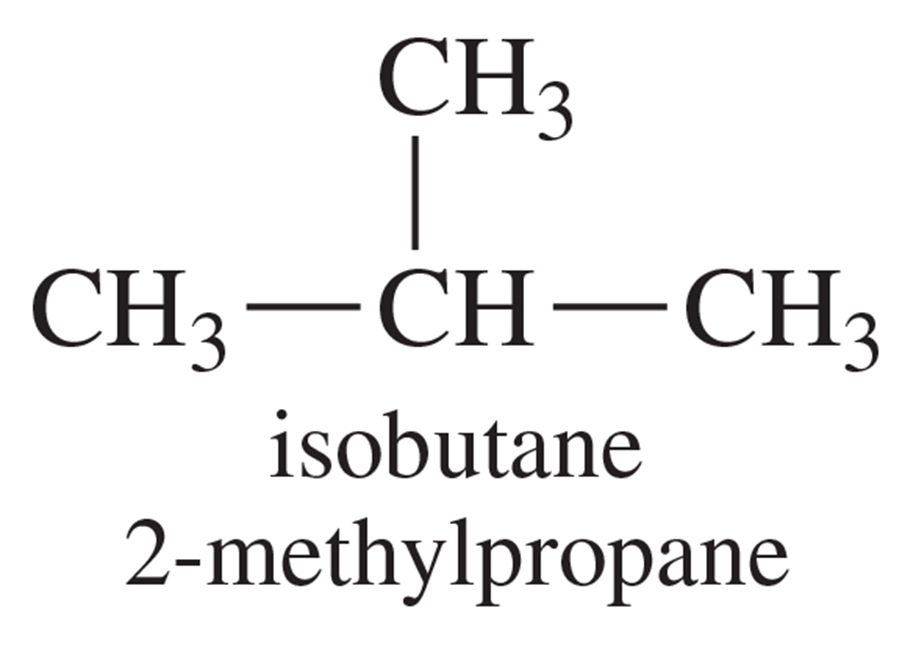
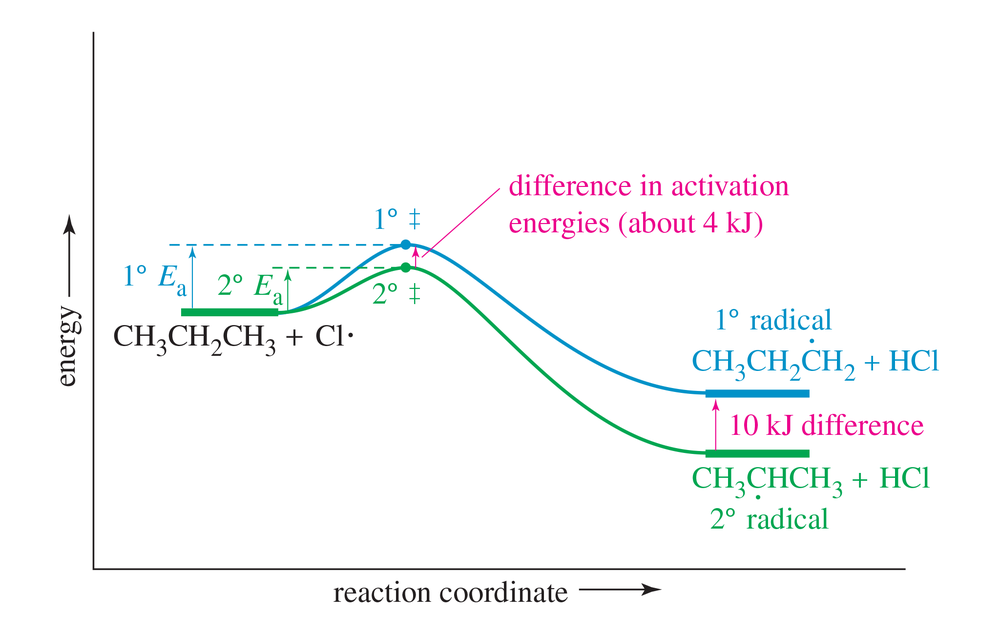
Use the bond-dissociation enthalpies in Table 4-2 (page 167) to calculate the heats of reaction for the two possible first propagation steps in the chlorination of isobutane. Use this information to draw a reaction-energy diagram like Figure 4-8, comparing the activation energies for formation of the two radicals.
Verified step by step guidance
1
Step 1: Identify the two possible propagation steps in the chlorination of isobutane. The first propagation step involves the abstraction of a hydrogen atom from either a primary carbon or a tertiary carbon in isobutane by a chlorine radical (Cl•). This results in the formation of either a primary radical or a tertiary radical.
Step 2: Use the bond-dissociation enthalpy values from TABLE 4-2 to calculate the energy required to break the C-H bond in isobutane. For the primary C-H bond, the bond-dissociation enthalpy is 423 kJ/mol. For the tertiary C-H bond, the bond-dissociation enthalpy is 400 kJ/mol.
Step 3: Calculate the energy released when the H-Cl bond is formed in the propagation step. The bond-dissociation enthalpy for the H-Cl bond is 431 kJ/mol. Subtract the bond-dissociation enthalpy of the C-H bond from the energy released by the formation of the H-Cl bond to determine the heat of reaction for each propagation step.
Step 4: Compare the heats of reaction for the two propagation steps. The step involving the tertiary C-H bond will likely have a lower activation energy and be more exothermic due to the stability of the tertiary radical compared to the primary radical.
Step 5: Draw a reaction-energy diagram similar to FIGURE 4-8. Represent the energy difference between the activation energies for the formation of the primary and tertiary radicals, as well as the difference in the overall energy change (ΔH) for the two propagation steps. Highlight that the tertiary radical formation has a lower activation energy and is more thermodynamically favorable.
Verified video answer for a similar problem:
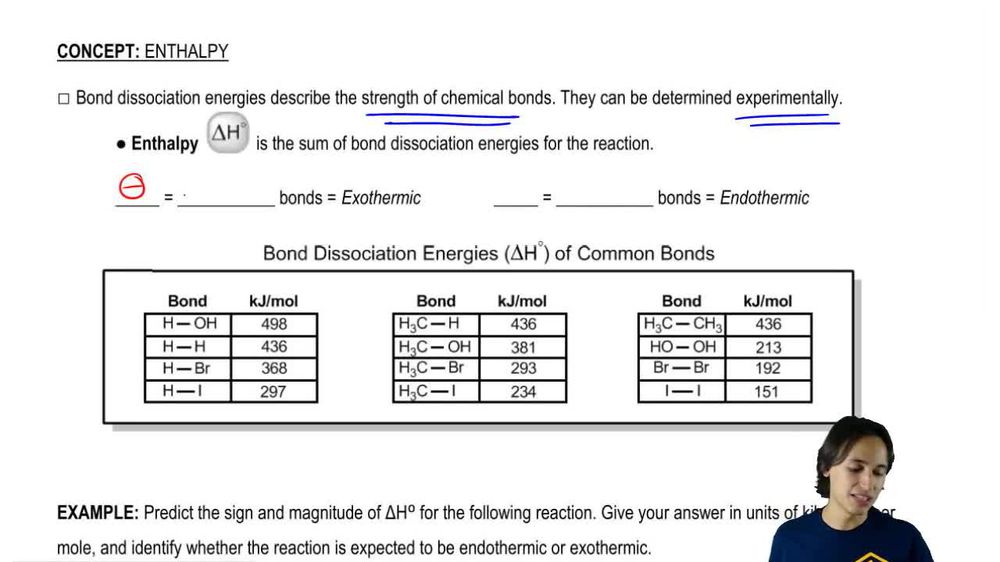
This video solution was recommended by our tutors as helpful for the problem above
Video duration:
10m
Play a video:
0 Comments
Key Concepts
Here are the essential concepts you must grasp in order to answer the question correctly.
Bond-Dissociation Enthalpy
Bond-dissociation enthalpy (BDE) is the energy required to break a specific bond in a molecule, resulting in the formation of free radicals. It is a crucial concept in understanding reaction mechanisms, as it helps predict the stability of intermediates and the overall energy changes during a reaction. In the context of chlorination, BDE values for C-H and C-Cl bonds will be essential for calculating the heats of reaction for the propagation steps.
How to calculate enthalpy using bond dissociation energies.
Propagation Steps in Radical Reactions
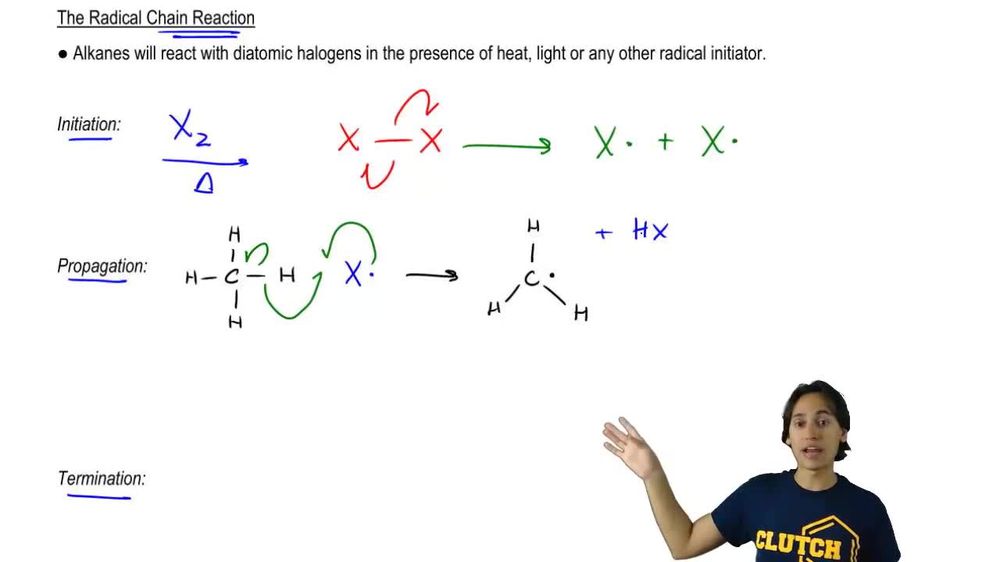
Propagation steps are the stages in a radical chain reaction where radicals react with stable molecules to form new radicals, continuing the reaction cycle. In the chlorination of isobutane, the first propagation steps involve the reaction of chlorine radicals with isobutane to form new radicals. Understanding these steps is vital for calculating the heats of reaction and determining the preferred pathway based on activation energies.
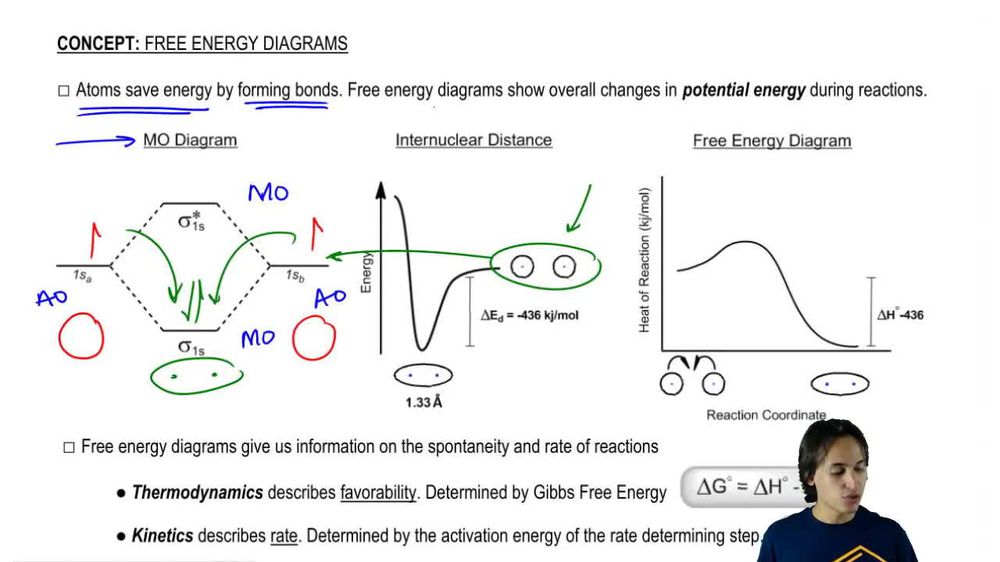
A reaction-energy diagram visually represents the energy changes during a chemical reaction, illustrating the relative energies of reactants, products, and transition states. It helps in comparing activation energies for different pathways, such as the formation of various radicals in the chlorination of isobutane. By analyzing these diagrams, one can infer the feasibility and rate of reactions based on the energy barriers involved.