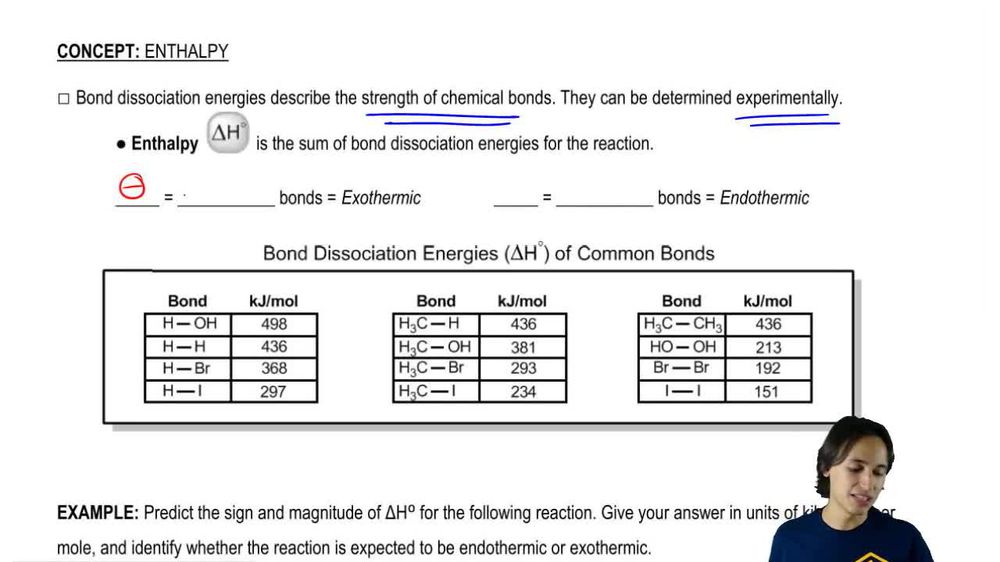
Tributyltin hydride (Bu3SnH) is used synthetically to reduce alkyl halides, replacing a halogen atom with hydrogen. Free-radical initiators promote this reaction, and free-radical inhibitors are known to slow or stop it. Your job is to develop a mechanism, using the following reaction as the example. The following bond-dissociation enthalpies may be helpful: b. Calculate values of ΔH for your proposed steps to show that they are energetically feasible. (Hint: A trace of Br2 and light suggests it’s there only as an initiator, to create Br• radicals. Then decide which atom can be abstracted most favorably from the starting materials by the Br• radical. That should complete the initiation. Finally, decide what energetically favored propagation steps will accomplish the reaction.)
Verified step by step guidance
1
Step 1: Begin by analyzing the initiation step. The trace amount of Br2 and light (hv) suggests that Br2 undergoes homolytic cleavage to form two bromine radicals (Br⋅). This is the initiation step, and the bond-dissociation enthalpy for Br—Br is 190 kJ/mol. Write the equation for this step: Br2 → 2 Br⋅.
Step 2: Determine the most favorable atom abstraction by the Br⋅ radical. The bromine radical can abstract a hydrogen atom from Bu3SnH, forming Bu3Sn⋅ and HBr. The bond-dissociation enthalpy for Bu3Sn—H is 310 kJ/mol, and for H—Br is 366 kJ/mol. Write the equation for this step: Br⋅ + Bu3SnH → Bu3Sn⋅ + HBr.
Step 3: Analyze the propagation steps. The Bu3Sn⋅ radical can abstract a halogen atom (X⋅) from the alkyl halide (R—X), forming Bu3SnX and an alkyl radical (R⋅). The bond-dissociation enthalpy for Bu3Sn—Br is 552 kJ/mol, and for R—X (alkyl halide bond) is given as 309 kJ/mol. Write the equation for this step: Bu3Sn⋅ + R—X → Bu3SnX + R⋅.
Step 4: The alkyl radical (R⋅) can then abstract a hydrogen atom from Bu3SnH, regenerating Bu3Sn⋅ and forming the alkane (R—H). This completes the propagation cycle. Write the equation for this step: R⋅ + Bu3SnH → R—H + Bu3Sn⋅.
Step 5: Calculate the ΔH values for each step to confirm energetic feasibility. Use the bond-dissociation enthalpies provided to calculate ΔH for each reaction step. For example, ΔH = bonds broken - bonds formed. Ensure that the overall ΔH for the propagation steps is negative, indicating that the reaction is energetically favorable.
Verified video answer for a similar problem:
This video solution was recommended by our tutors as helpful for the problem above
Video duration:
14m
Play a video:
0 Comments
Key Concepts
Here are the essential concepts you must grasp in order to answer the question correctly.
Free Radical Mechanism
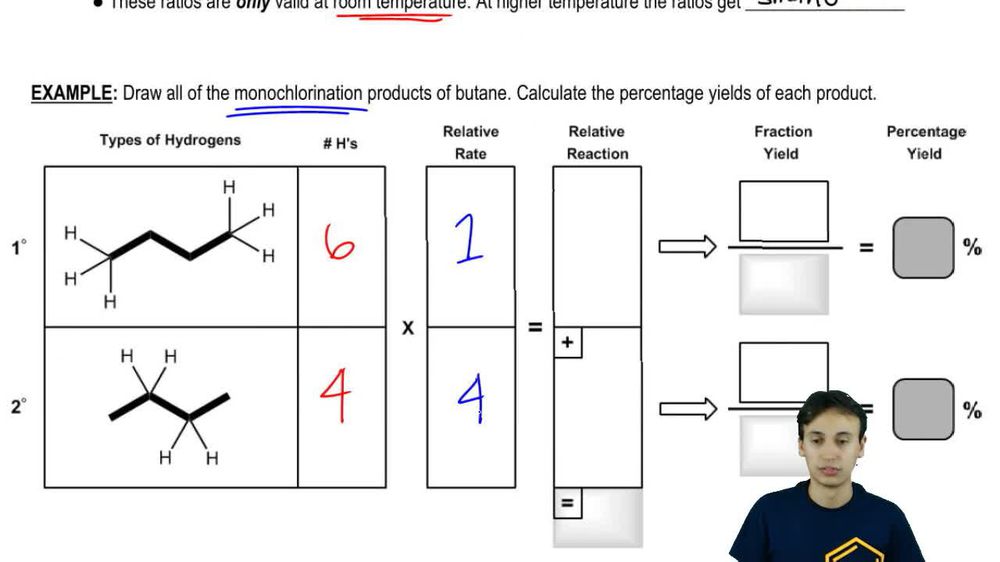
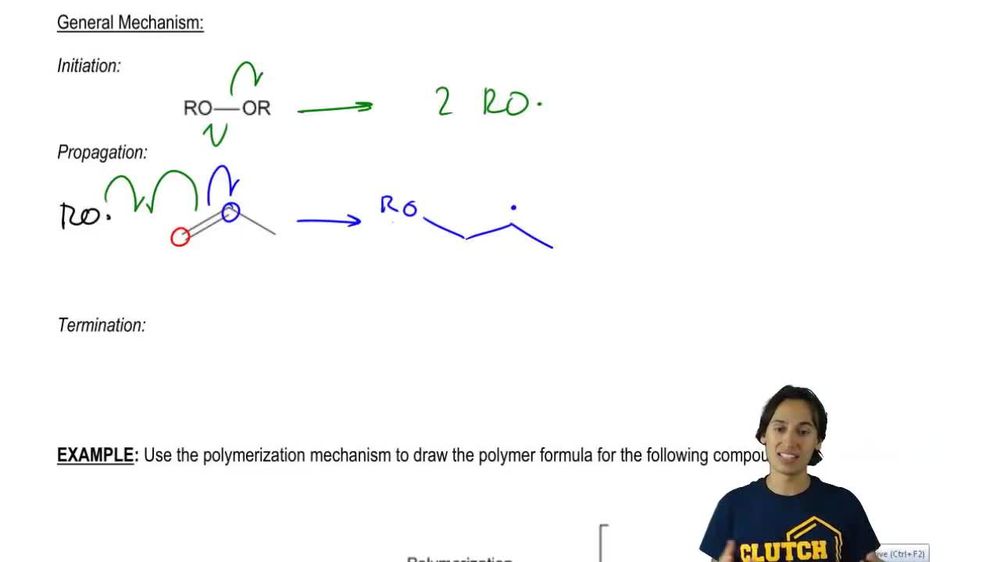
A free radical mechanism involves the formation and reaction of free radicals, which are highly reactive species with unpaired electrons. In the context of the reaction with tributyltin hydride, the initiation step generates bromine radicals (Br·) from Br2 under light exposure. These radicals can then abstract hydrogen from the alkyl halide, leading to the formation of a new radical and the corresponding alkyl bromide.
Bond dissociation enthalpy is the energy required to break a specific bond in a molecule, resulting in the formation of free radicals. Understanding BDE is crucial for predicting the feasibility of the reaction steps. For instance, comparing the BDEs of the bonds involved in the reaction helps determine which bonds are more easily broken, guiding the selection of the most favorable hydrogen abstraction during the propagation steps.
How to calculate enthalpy using bond dissociation energies.
Energetic Feasibility and ΔH Calculation
Energetic feasibility refers to whether a reaction can occur based on the energy changes associated with bond breaking and forming. The change in enthalpy (ΔH) for each step can be calculated using the bond dissociation enthalpies provided. A negative ΔH indicates that the reaction is exothermic and energetically favorable, which is essential for validating the proposed mechanism and ensuring that the reaction can proceed under the given conditions.

 14:59 minutes

 Verified step by step guidance
 03:28
03:28