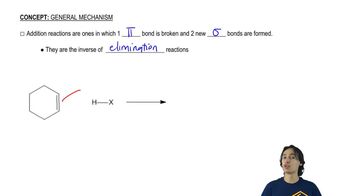
Draw the structures of four six-carbon alkenes that form the same product, whether they react with HBr in the presence of a peroxide or with HBr in the absence of a peroxide.
Verified step by step guidance
1
Identify the key concept: The problem involves the addition of HBr to alkenes. In the presence of a peroxide, the reaction follows the anti-Markovnikov rule (radical mechanism), while in the absence of a peroxide, it follows the Markovnikov rule (ionic mechanism). The goal is to find alkenes that yield the same product regardless of the mechanism.
Understand the structural requirement: For the product to be the same in both cases, the alkene must be symmetrical or structured such that the addition of HBr (whether Markovnikov or anti-Markovnikov) leads to the same product. This typically happens when the two carbons of the double bond are equally substituted or when the product is identical due to symmetry.
Draw the first structure: Consider a symmetrical alkene, such as 3-hexene. The double bond is in the middle of the chain, and both sides are identical. Adding HBr in either mechanism will yield the same product.
Draw the second structure: Consider a terminal alkene, such as 1-hexene. In this case, the addition of HBr will always result in the same product because the anti-Markovnikov and Markovnikov products are indistinguishable for this structure.
Draw additional structures: Explore other symmetrical or unique alkenes, such as 2,3-dimethyl-2-butene (a symmetrical alkene) or 2-hexene (cis or trans). These structures also satisfy the condition of forming the same product regardless of the reaction mechanism.
Verified video answer for a similar problem:
This video solution was recommended by our tutors as helpful for the problem above
Play a video:
0 Comments
Key Concepts
Here are the essential concepts you must grasp in order to answer the question correctly.
Alkenes and Their Structures
Alkenes are hydrocarbons that contain at least one carbon-carbon double bond (C=C). The presence of this double bond allows for geometric isomerism and influences the reactivity of the molecule. Understanding the structural representation of alkenes is crucial for predicting their behavior in chemical reactions, particularly in electrophilic additions.
Electrophilic addition is a fundamental reaction mechanism in organic chemistry where an electrophile reacts with a nucleophile, typically involving alkenes. In the case of HBr addition, the reaction can proceed via different pathways depending on the presence of peroxides, which can lead to anti-Markovnikov addition. Recognizing how these mechanisms differ is essential for predicting the products formed from the alkenes.
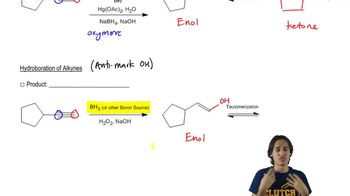
The peroxide effect refers to the phenomenon where the addition of HBr to alkenes in the presence of peroxides leads to the formation of products that follow anti-Markovnikov's rule. This means that the bromine atom attaches to the less substituted carbon atom of the double bond. Understanding this effect is key to determining the structures of the alkenes that yield the same product under both reaction conditions.

 Verified step by step guidance
 1:59
1:59