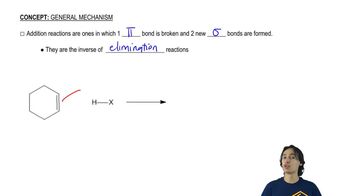
What alkyl halide will be obtained in greatest yield? Ignore stereoisomers. f.
Verified step by step guidance
1
Step 1: Analyze the reaction conditions. The presence of peroxide indicates that the reaction will follow the anti-Markovnikov addition mechanism due to the free radical pathway.
Step 2: Identify the structure of the alkene. The molecule contains a double bond between the CH=CH2 group and the cyclohexane ring. This is the reactive site for the addition of HBr.
Step 3: In the anti-Markovnikov mechanism, the bromine atom (Br) will add to the less substituted carbon of the double bond, while the hydrogen atom (H) will add to the more substituted carbon.
Step 4: Determine the less substituted carbon in the double bond. In this case, the terminal carbon of the CH=CH2 group is less substituted, while the internal carbon connected to the cyclohexane ring is more substituted.
Step 5: Predict the product. The bromine atom will attach to the terminal carbon of the CH=CH2 group, forming an alkyl halide with the bromine on the less substituted carbon. Ignore stereoisomers as instructed.
Verified video answer for a similar problem:
This video solution was recommended by our tutors as helpful for the problem above
Video duration:
3m
Play a video:
0 Comments
Key Concepts
Here are the essential concepts you must grasp in order to answer the question correctly.
Alkyl Halides
Alkyl halides are organic compounds containing a carbon atom bonded to a halogen atom (F, Cl, Br, I). They are formed through the substitution of hydrogen atoms in alkanes with halogen atoms. The reactivity and stability of alkyl halides depend on the structure of the carbon chain and the nature of the halogen, influencing their formation and yield in reactions.
Markovnikov's Rule states that in the addition of HX (where X is a halogen) to an alkene, the hydrogen atom will attach to the carbon with the greater number of hydrogen atoms already attached. This rule helps predict the major product of the reaction, guiding the formation of more stable carbocations and thus influencing the yield of the resulting alkyl halide.
In the presence of peroxides, the addition of HBr to alkenes can proceed via a radical mechanism, which differs from the typical ionic mechanism. This process leads to the formation of the less stable radical intermediate, resulting in the anti-Markovnikov product. Understanding this mechanism is crucial for predicting the major alkyl halide product and its yield in the reaction.

 3:17 minutes
 Verified step by step guidance
 01:52
01:52