In the mass spectrum of the following compounds, which is the tallest—the peak at m/z = 57 or the peak at m/z = 71? a. 3-methylpentane b. 2-methylpentane
Verified step by step guidance
1
Step 1: Understand the problem. The question is asking about the relative intensities of peaks at m/z = 57 and m/z = 71 in the mass spectra of two isomers: 3-methylpentane and 2-methylpentane. The tallest peak corresponds to the most stable fragment ion formed during fragmentation in the mass spectrometer.
Step 2: Recall the concept of fragmentation in mass spectrometry. When a molecule is ionized, it can break into smaller fragments. The stability of these fragments determines the intensity of the corresponding peaks in the mass spectrum. More stable fragments produce taller peaks.
Step 3: Analyze the fragmentation of 3-methylpentane. For m/z = 57, the fragment corresponds to a tert-butyl cation (C4H9+), which is highly stable due to hyperconjugation and inductive effects. For m/z = 71, the fragment corresponds to a primary carbocation (C5H11+), which is less stable.
Step 4: Analyze the fragmentation of 2-methylpentane. For m/z = 57, the fragment corresponds to a secondary carbocation (C4H9+), which is moderately stable. For m/z = 71, the fragment corresponds to a secondary carbocation (C5H11+), which is also moderately stable.
Step 5: Compare the stability of the fragments. In 3-methylpentane, the peak at m/z = 57 is taller because the tert-butyl cation is more stable than the primary carbocation at m/z = 71. In 2-methylpentane, the peaks at m/z = 57 and m/z = 71 are closer in intensity because both correspond to secondary carbocations with similar stability. Thus, the tallest peak depends on the compound being analyzed.
Verified video answer for a similar problem:
This video solution was recommended by our tutors as helpful for the problem above
Video duration:
6m
Play a video:
0 Comments
Key Concepts
Here are the essential concepts you must grasp in order to answer the question correctly.
Mass Spectrometry
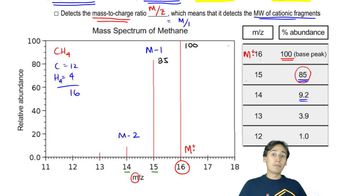
Mass spectrometry is an analytical technique used to measure the mass-to-charge ratio of ions. It helps identify the composition of a sample by generating a mass spectrum, which displays peaks corresponding to different ions. The height of each peak indicates the relative abundance of the corresponding ion, allowing for the comparison of different compounds based on their fragmentation patterns.
Fragmentation patterns refer to the specific ways in which a molecule breaks apart into smaller ions during mass spectrometry. Different compounds will produce characteristic fragments based on their structure, which can be predicted using knowledge of organic chemistry. Understanding these patterns is crucial for interpreting mass spectra and determining which peaks correspond to which compounds.
Isomeric compounds, such as 3-methylpentane and 2-methylpentane, have the same molecular formula but different structural arrangements. This structural difference can lead to variations in their fragmentation patterns and, consequently, their mass spectra. Recognizing how isomers can affect peak heights in a mass spectrum is essential for accurately determining which compound produces the tallest peak at a given m/z value.