What products would you expect to obtain from the following reactions? a. malonic acid + 2 acetyl chloride
Verified step by step guidance
1
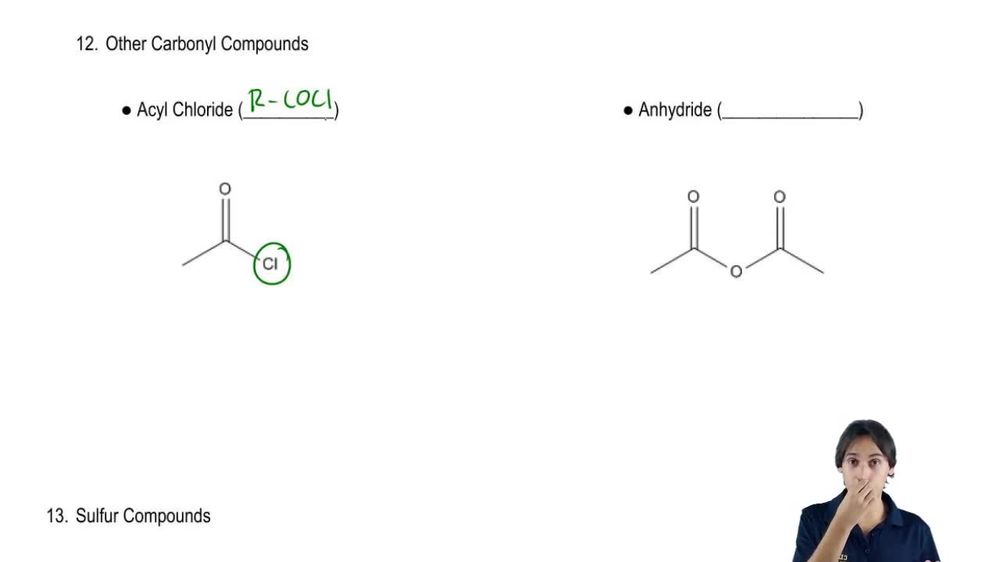
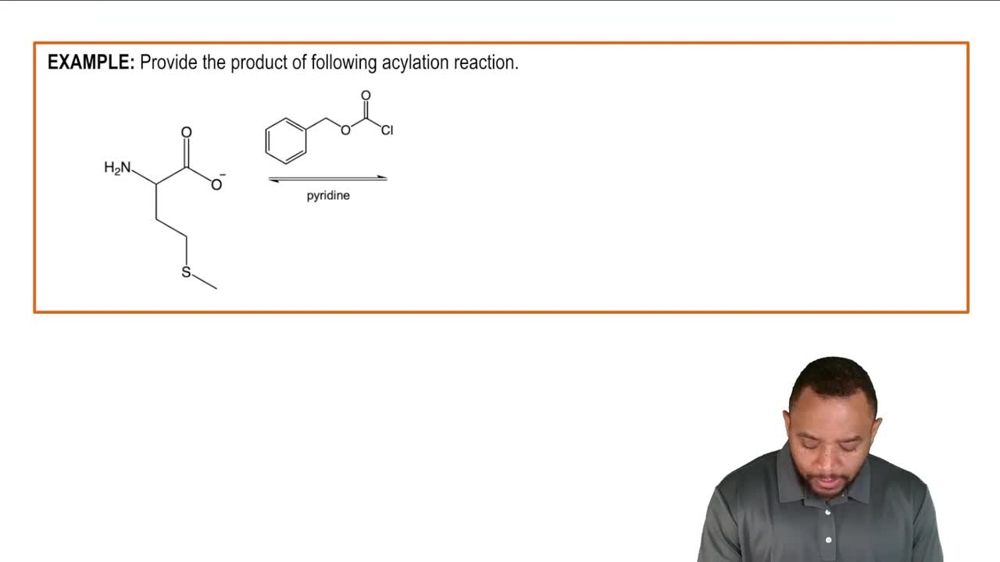
Step 1: Recognize the functional groups in the reactants. Malonic acid contains two carboxylic acid groups (-COOH), and acetyl chloride is an acid chloride (-COCl). Acid chlorides are highly reactive and can undergo acylation reactions with nucleophiles like the hydroxyl groups in malonic acid.
Step 2: Understand the reaction mechanism. The hydroxyl group (-OH) of malonic acid will act as a nucleophile and attack the carbonyl carbon of acetyl chloride. This results in the formation of an ester bond and the release of HCl as a byproduct.
Step 3: Consider the stoichiometry of the reaction. Since there are two hydroxyl groups in malonic acid and two molecules of acetyl chloride, each hydroxyl group can react with one acetyl chloride molecule, leading to the formation of a diester.
Step 4: Write the structure of the product. The product will be a diester where both carboxylic acid groups of malonic acid are converted into ester groups by reacting with acetyl chloride. The general structure will be CH2(COOR)2, where R is the acetyl group (CH3CO).
Step 5: Account for byproducts. Each reaction between a hydroxyl group and acetyl chloride releases HCl as a byproduct. Since two acetyl chloride molecules are used, two molecules of HCl will be produced in this reaction.
Verified video answer for a similar problem:
This video solution was recommended by our tutors as helpful for the problem above
Video duration:
3m
Play a video:
0 Comments
Key Concepts
Here are the essential concepts you must grasp in order to answer the question correctly.
Malonic Acid
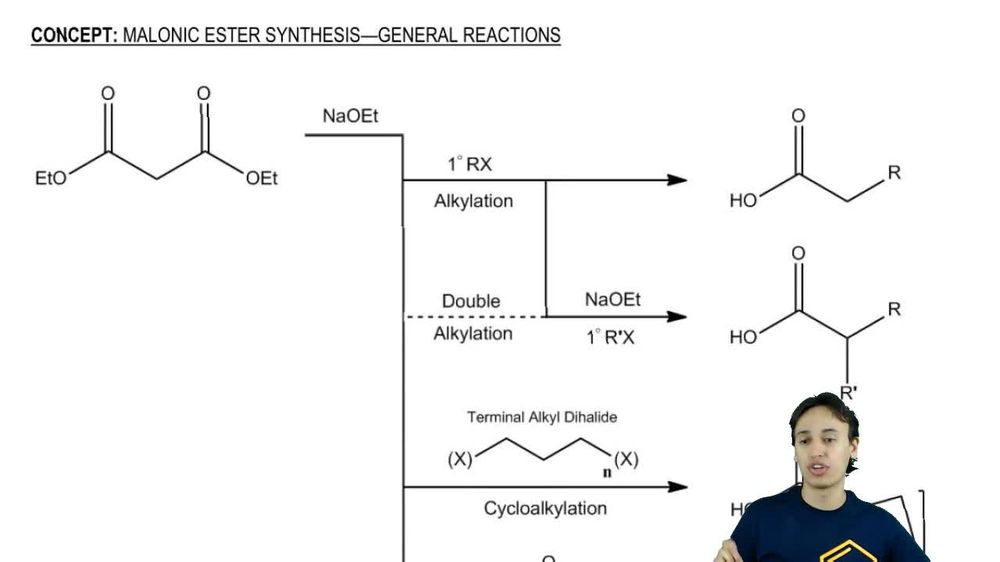
Malonic acid is a dicarboxylic acid with the formula C3H4O4. It contains two carboxyl groups (-COOH) and is commonly used in organic synthesis. Its structure allows it to undergo various reactions, including esterification and acylation, making it a versatile building block in the synthesis of more complex molecules.
Acyl chlorides, also known as acid chlorides, are derivatives of carboxylic acids where the hydroxyl group is replaced by a chlorine atom. They are highly reactive and are often used in acylation reactions to introduce acyl groups into organic compounds. In the presence of nucleophiles, acyl chlorides readily react to form esters, amides, or other acyl derivatives.
When malonic acid reacts with acyl chlorides, it typically undergoes a reaction known as acylation, leading to the formation of malonic acid derivatives. In this case, two acetyl chlorides would introduce two acetyl groups into the malonic acid structure, resulting in the formation of a diacetyl derivative. This reaction is significant in synthetic organic chemistry for constructing complex molecules.

 3:50 minutes
 Verified step by step guidance
 01:25
01:25