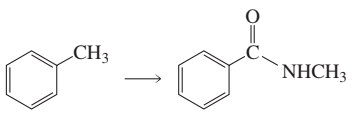
Show how the following compounds can be prepared from the given starting materials. You can use any necessary organic or inorganic reagents. a.
Verified step by step guidance
1
Step 1: Begin with the starting material, toluene (C6H5CH3). The methyl group on the benzene ring will serve as the site for functionalization.
Step 2: Perform a benzylic oxidation of the methyl group using a strong oxidizing agent such as KMnO4 or Na2Cr2O7 under acidic conditions. This will convert the methyl group (-CH3) into a carboxylic acid group (-COOH), yielding benzoic acid (C6H5COOH).
Step 3: Convert the benzoic acid into an acid chloride (-COCl) by treating it with thionyl chloride (SOCl2). This reaction replaces the hydroxyl group (-OH) of the carboxylic acid with a chlorine atom, forming benzoyl chloride (C6H5COCl).
Step 4: React the benzoyl chloride with ethylamine (CH3CH2NH2) in the presence of a base such as pyridine. This nucleophilic acyl substitution will replace the chlorine atom with the ethylamine group, forming the desired amide product, N-ethylbenzamide (C6H5CONHCH2CH3).
Step 5: Purify the final product using standard organic purification techniques such as recrystallization or chromatography to ensure the desired compound is obtained in high purity.
Verified video answer for a similar problem:
This video solution was recommended by our tutors as helpful for the problem above
Video duration:
6m
Play a video:
0 Comments
Key Concepts
Here are the essential concepts you must grasp in order to answer the question correctly.
Nucleophilic Acyl Substitution
Nucleophilic acyl substitution is a fundamental reaction in organic chemistry where a nucleophile attacks an acyl compound, leading to the replacement of a leaving group with the nucleophile. In this process, the carbonyl carbon becomes electrophilic, allowing the nucleophile to form a tetrahedral intermediate, which then collapses to release the leaving group and form a new carbonyl compound.
Nucleophiles and Electrophiles can react in Substitution Reactions.
Reactivity of Aromatic Compounds
Aromatic compounds, such as toluene, exhibit unique reactivity due to their stable π-electron system. This stability allows them to undergo electrophilic aromatic substitution rather than nucleophilic reactions. However, under certain conditions, aromatic compounds can participate in nucleophilic acyl substitution, especially when activated by electron-withdrawing groups or when reacting with acyl chlorides or anhydrides.
Amides are formed when a carboxylic acid or its derivative reacts with an amine. In the context of nucleophilic acyl substitution, the amine acts as the nucleophile, attacking the carbonyl carbon of the acyl compound. This reaction is crucial in organic synthesis, as amides are important functional groups found in various natural products and pharmaceuticals.