What compounds are obtained from the following hydrolysis reactions? d.
Verified step by step guidance
1
Identify the functional group in the compound: The given compound contains two ester groups. Esters undergo hydrolysis in the presence of water, typically catalyzed by an acid or base.
Understand the reaction mechanism: During hydrolysis, the ester bond is cleaved, resulting in the formation of a carboxylic acid and an alcohol. Each ester group will produce one carboxylic acid and one alcohol.
Analyze the structure: The first ester group (connected to the cyclopentane ring) will yield cyclopentane carboxylic acid (C5H9COOH) and ethanol (CH3CH2OH) upon hydrolysis.
Analyze the second ester group: The second ester group (connected to the ethyl group) will yield propanoic acid (CH3CH2COOH) and ethanol (CH3CH2OH) upon hydrolysis.
Combine the products: The hydrolysis of the given compound will result in two carboxylic acids (cyclopentane carboxylic acid and propanoic acid) and two alcohol molecules (ethanol).
Verified video answer for a similar problem:
This video solution was recommended by our tutors as helpful for the problem above
Video duration:
2m
Play a video:
0 Comments
Key Concepts
Here are the essential concepts you must grasp in order to answer the question correctly.
Hydrolysis of Carboxylic Acid Derivatives
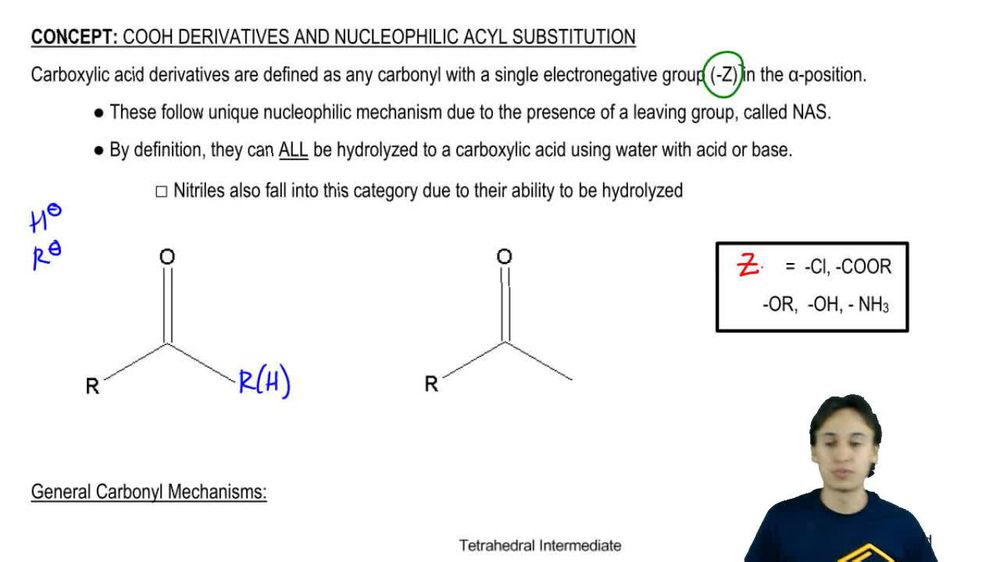
Hydrolysis is a chemical reaction involving the breaking of a bond in a molecule using water. In the context of carboxylic acid derivatives, such as esters or anhydrides, hydrolysis typically results in the formation of a carboxylic acid and an alcohol or another relevant product. Understanding this reaction is crucial for predicting the products formed when these compounds react with water.
Functional groups are specific groups of atoms within molecules that are responsible for the characteristic chemical reactions of those molecules. In the given reaction, the presence of carbonyl groups (C=O) indicates that the compound is likely a carboxylic acid derivative. Recognizing these functional groups helps in predicting the behavior of organic compounds during chemical reactions.
A reaction mechanism is a step-by-step description of how a chemical reaction occurs at the molecular level. For hydrolysis reactions, understanding the mechanism can help explain how water interacts with the substrate, leading to the cleavage of bonds and formation of products. This knowledge is essential for predicting the outcome of the reaction and understanding the stability of intermediates formed during the process.

 2:53 minutes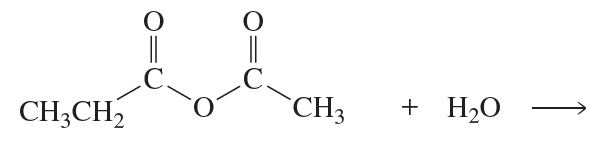
 Verified step by step guidance
 03:50
03:50