Ch. 17 - Reactions at the Alpha-Carbon
Bruice - Organic Chemistry 8th Edition
Bruice8th EditionOrganic ChemistryISBN: 9780135213711Not the one you use?Change textbook
Chapter 18, Problem 19a

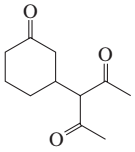
What reagents should be used to prepare the following compounds?
a. Chemical structure of a compound featuring carbon rings and functional groups, with labels for oxygen atoms.

Verified step by step guidance
1
Step 1: Analyze the target compound. The structure contains a cyclopentanone ring, a tertiary carbon attached to two ketone groups, and a methyl group. This suggests a multi-step synthesis involving carbon-carbon bond formation and functional group transformations.
Step 2: Identify the key transformations. The tertiary carbon with two ketone groups can be formed via an aldol condensation reaction, followed by dehydration. The cyclopentanone ring can be introduced using a precursor cyclopentanone.
Step 3: Select the starting materials. Cyclopentanone can be used as the base structure. Acetone can serve as the source for the methyl group and one of the ketone functionalities.
Step 4: Perform the aldol condensation. React cyclopentanone with acetone in the presence of a base (e.g., NaOH or KOH). This will form a β-hydroxyketone intermediate. Heat the reaction mixture to induce dehydration, forming the α,β-unsaturated ketone.
Step 5: Add a second equivalent of acetone to the α,β-unsaturated ketone under basic conditions to form the tertiary carbon with two ketone groups. This step involves another aldol addition followed by dehydration.

Verified video answer for a similar problem:

This video solution was recommended by our tutors as helpful for the problem above.
Video duration:
5m
Was this helpful?

Key Concepts

Here are the essential concepts you must grasp in order to answer the question correctly.

Michael Addition

Michael addition is a nucleophilic addition reaction where a nucleophile adds to an α,β-unsaturated carbonyl compound. This reaction typically involves the addition of a carbanion or another nucleophile to the β-carbon of the unsaturated system, resulting in the formation of a new carbon-carbon bond. Understanding this mechanism is crucial for determining the appropriate reagents needed to synthesize compounds through this pathway.
Recommended video:
Guided course
09:23
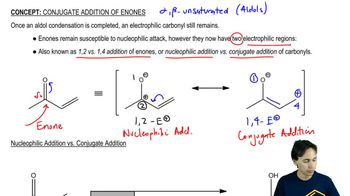
1,2 vs 1,4 Addition

Reagents for Michael Addition

Common reagents used in Michael addition include strong nucleophiles such as enolates, which can be generated from carbonyl compounds like ketones or aldehydes. Additionally, the α,β-unsaturated carbonyl compound can be a compound like an α,β-unsaturated ketone or ester. Identifying the correct nucleophile and the unsaturated carbonyl compound is essential for successfully carrying out the reaction and obtaining the desired product.
Recommended video:
Guided course
09:23
1,2 vs 1,4 Addition

Stereochemistry in Organic Reactions

Stereochemistry plays a significant role in organic reactions, particularly in the formation of chiral centers during reactions like Michael addition. The spatial arrangement of atoms can affect the reactivity and the outcome of the reaction, leading to different stereoisomers. Understanding how to control or predict stereochemical outcomes is important for synthesizing specific compounds with desired properties.
Recommended video:
1:38
Polymer Stereochemistry Concept 1