Given the molecular formula, calculate the index of hydrogen deficiency. (a) C6H14O
Verified step by step guidance
1
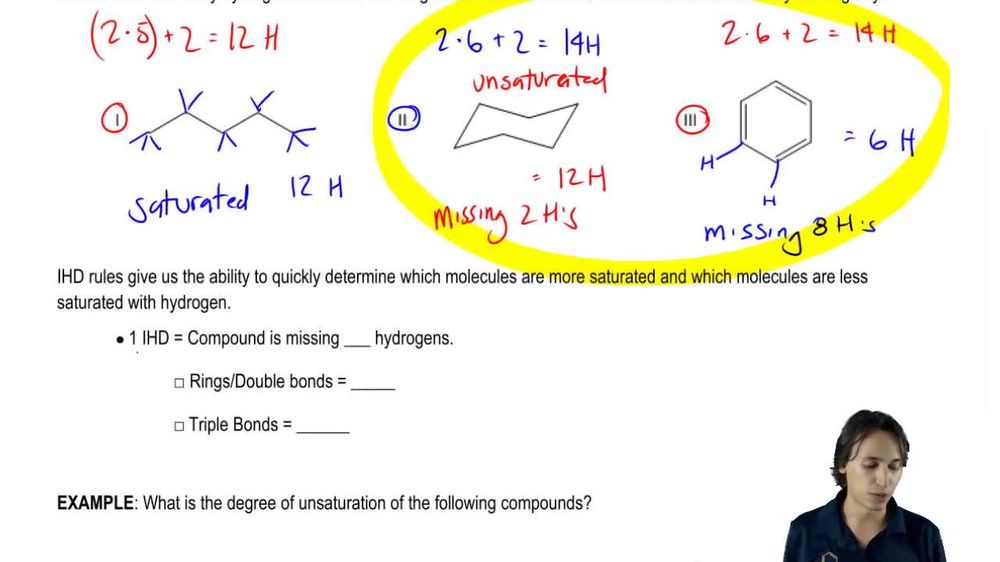
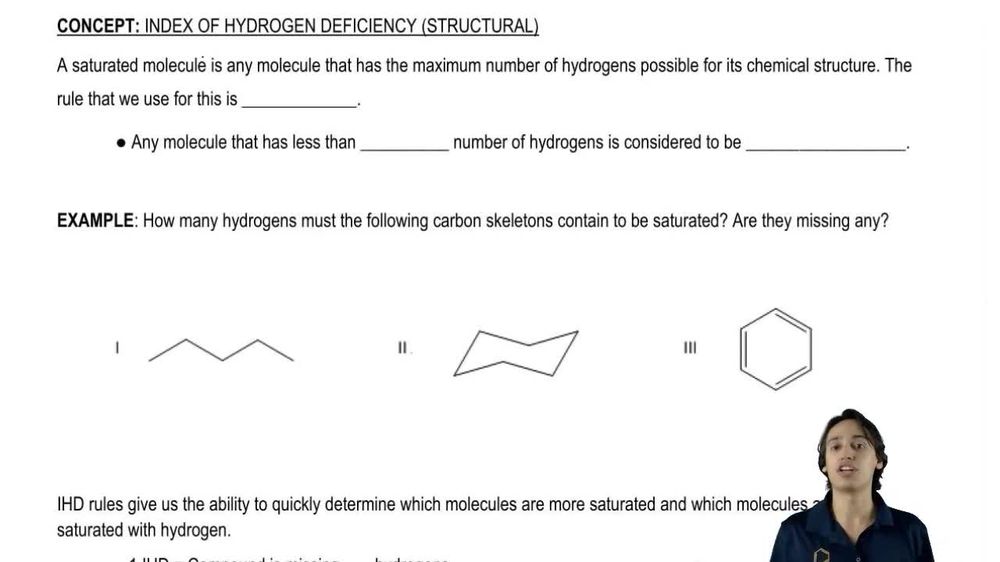
Step 1: Understand the concept of the Index of Hydrogen Deficiency (IHD). The IHD, also known as the degree of unsaturation, indicates the number of rings, double bonds, or triple bonds in a molecule. Each ring or double bond reduces the number of hydrogens by 2, while a triple bond reduces it by 4.
Step 2: Recall the formula for calculating IHD: IHD = (2C + 2 - H + N - X) / 2, where C is the number of carbons, H is the number of hydrogens, N is the number of nitrogens, and X is the number of halogens. For oxygen (O), it does not affect the IHD calculation and is ignored.
Step 3: Substitute the given molecular formula into the IHD formula. For C₆H₁₄O, the number of carbons (C) is 6, the number of hydrogens (H) is 14, and there are no nitrogens (N = 0) or halogens (X = 0). The formula simplifies to IHD = (2(6) + 2 - 14) / 2.
Step 4: Simplify the expression inside the parentheses. Calculate 2(6) + 2, then subtract 14.
Step 5: Divide the result from Step 4 by 2 to determine the IHD. This will give you the final value of the Index of Hydrogen Deficiency for the molecule C₆H₁₄O.
Verified video answer for a similar problem:
This video solution was recommended by our tutors as helpful for the problem above
Play a video:
0 Comments
Key Concepts
Here are the essential concepts you must grasp in order to answer the question correctly.
Molecular Formula
A molecular formula represents the number and types of atoms in a molecule. It provides essential information about the composition of a compound, indicating how many of each element are present. For example, C₆H₁₄O indicates there are six carbon atoms, fourteen hydrogen atoms, and one oxygen atom in the molecule.
The Index of Hydrogen Deficiency (IHD) is a measure of the degree of unsaturation in a molecule, indicating the number of rings and/or multiple bonds present. It can be calculated using the formula IHD = (2C + 2 + N - H - X) / 2, where C is the number of carbons, N is the number of nitrogens, H is the number of hydrogens, and X is the number of halogens. A higher IHD suggests more unsaturation, which affects the molecule's reactivity and structure.
Unsaturation refers to the presence of double or triple bonds between carbon atoms or the presence of rings in organic compounds. These features reduce the number of hydrogen atoms that can be attached to the carbon skeleton compared to a saturated compound. Understanding unsaturation is crucial for predicting the reactivity and stability of organic molecules, as well as for determining their structural characteristics.

 Verified step by step guidance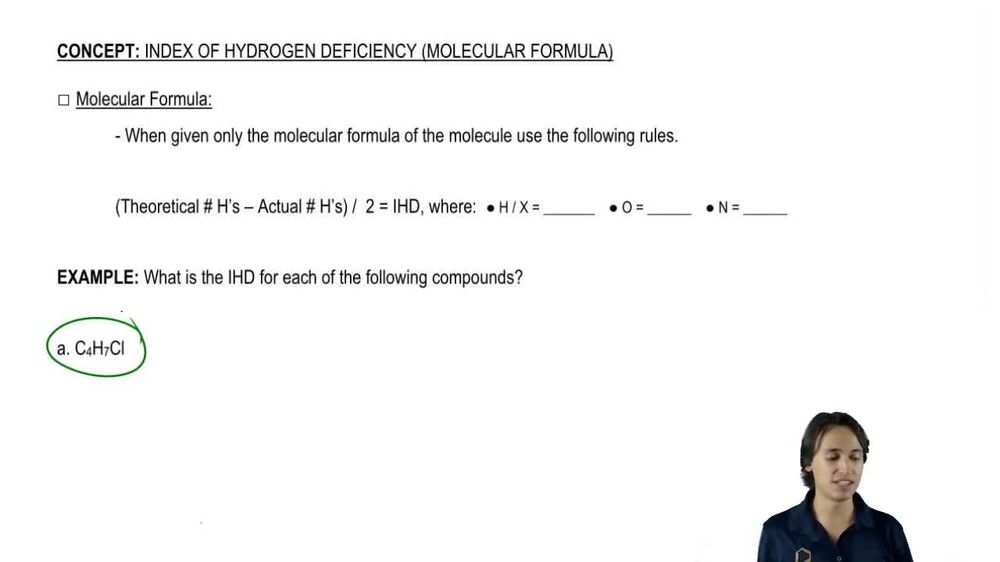
 02:17
02:17