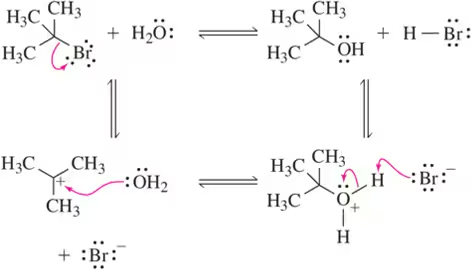
We discuss the following reactions in subsequent chapters. Given the mechanisms shown, draw the mechanism of the reverse reaction. (a)
Verified step by step guidance
1
Step 1: Identify the forward reaction mechanism provided in the problem. Carefully analyze the steps involved, including bond formation, bond breaking, and electron movement.
Step 2: Understand the reverse reaction concept. The reverse reaction mechanism is essentially the backward process of the forward reaction, where the products revert to the reactants.
Step 3: Reverse the electron flow in each step of the forward mechanism. For example, if a nucleophile attacks an electrophile in the forward reaction, the reverse reaction will involve the departure of the nucleophile from the electrophile.
Step 4: Ensure that all intermediates and transition states in the reverse mechanism correspond to those in the forward mechanism but in reverse order. Pay attention to resonance structures, charges, and stereochemistry.
Step 5: Draw the complete reverse mechanism step by step, showing all curved arrows to indicate electron movement, and verify that the reactants of the forward reaction are regenerated as products in the reverse reaction.
Verified video answer for a similar problem:
This video solution was recommended by our tutors as helpful for the problem above
Video duration:
5m
Play a video:
0 Comments
Key Concepts
Here are the essential concepts you must grasp in order to answer the question correctly.
Reaction Mechanisms
Reaction mechanisms describe the step-by-step process by which reactants are converted into products. Understanding these mechanisms is crucial for predicting the outcome of a reaction, including the reverse reaction. Each step involves the breaking and forming of bonds, and the movement of electrons, which can be illustrated using curved arrows in organic chemistry.
Many chemical reactions are reversible, meaning that the products can react to regenerate the original reactants. The extent to which a reaction can proceed in either direction is influenced by factors such as temperature, concentration, and the presence of catalysts. Recognizing the conditions that favor the reverse reaction is essential for accurately drawing its mechanism.
Curved arrow notation is a visual representation used in organic chemistry to depict the movement of electrons during chemical reactions. Arrows indicate the direction of electron flow, showing how bonds are formed and broken. Mastery of this notation is vital for illustrating both forward and reverse reaction mechanisms clearly and accurately.