Imagine an electrophilic addition where the first step is exothermic. Which carbocation—2°, 3°, or neither—would you expect to form preferentially? Explain.
Verified step by step guidance
1
Begin by understanding the concept of electrophilic addition. This is a reaction where an electrophile reacts with a nucleophile, typically an alkene, to form a carbocation intermediate.
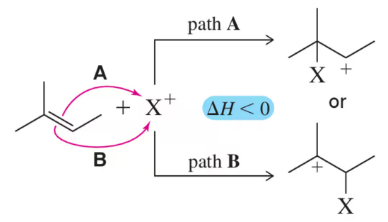
Examine the image provided. It shows two possible pathways for the formation of carbocations: Path A leading to a secondary (2°) carbocation and Path B leading to a tertiary (3°) carbocation.
Note the exothermic nature of the first step, indicated by ΔH < 0. This suggests that the reaction releases energy, favoring the formation of a more stable carbocation.
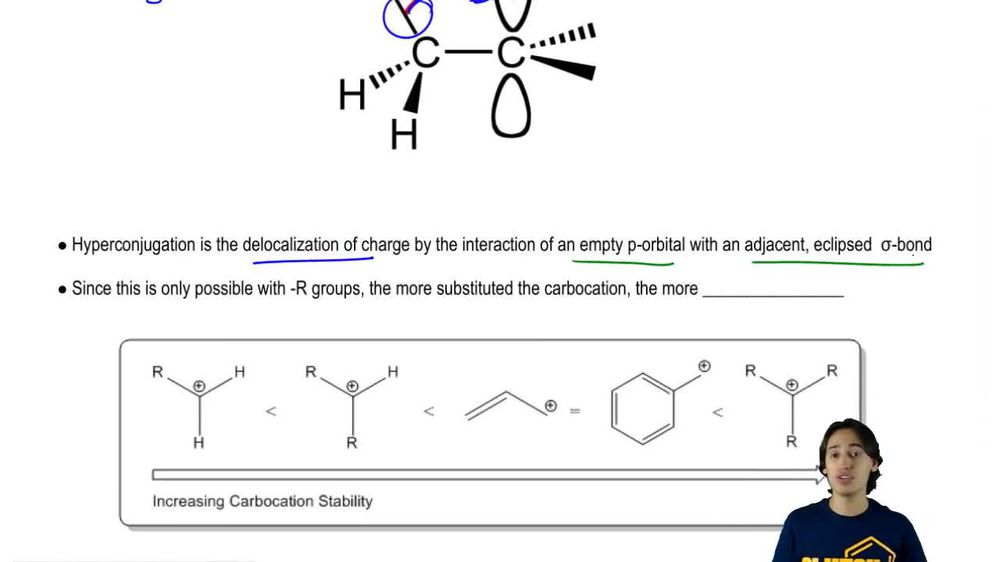
Consider the stability of carbocations. Tertiary (3°) carbocations are generally more stable than secondary (2°) carbocations due to greater hyperconjugation and inductive effects from surrounding alkyl groups.
Based on the stability preference and the exothermic nature of the reaction, the tertiary (3°) carbocation is expected to form preferentially, as it is more stable and the reaction favors the formation of the most stable intermediate.
Verified video answer for a similar problem:
This video solution was recommended by our tutors as helpful for the problem above
Play a video:
0 Comments
Key Concepts
Here are the essential concepts you must grasp in order to answer the question correctly.
Electrophilic Addition
Electrophilic addition is a reaction mechanism where an electrophile reacts with a nucleophile, typically involving alkenes or alkynes. In this process, the double or triple bond is broken, allowing the electrophile to bond with one of the carbon atoms, leading to the formation of a carbocation intermediate. The stability of the carbocation formed is crucial in determining the reaction pathway and the final product.
Carbocation stability is influenced by the degree of substitution on the positively charged carbon atom. Tertiary (3°) carbocations are more stable than secondary (2°) due to hyperconjugation and inductive effects from surrounding alkyl groups. This stability affects the likelihood of forming a particular carbocation during electrophilic addition reactions, with more stable carbocations being favored in the reaction pathway.
An exothermic reaction is one that releases energy, usually in the form of heat, during the reaction process. In the context of electrophilic addition, if the first step is exothermic, it suggests that the formation of the carbocation is energetically favorable. This can influence the reaction mechanism, potentially favoring the formation of more stable carbocations, such as tertiary ones, over less stable options.