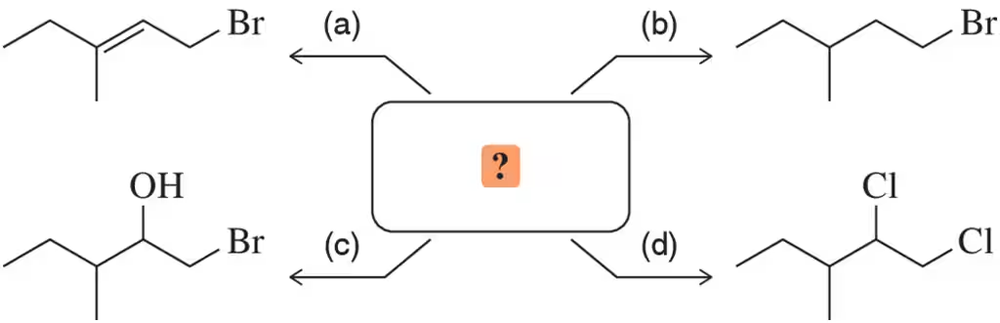
The following haloalkanes can all be prepared starting from the same alkene. Give the alkene and the reagents needed for each.
Verified step by step guidance
1
Identify the haloalkanes given in the problem. Haloalkanes are organic compounds containing halogens (such as Cl, Br, I) attached to an alkane chain.
Determine the structure of the alkene that can serve as a precursor to these haloalkanes. Consider the position of the halogen in the haloalkanes to deduce the possible structure of the alkene.
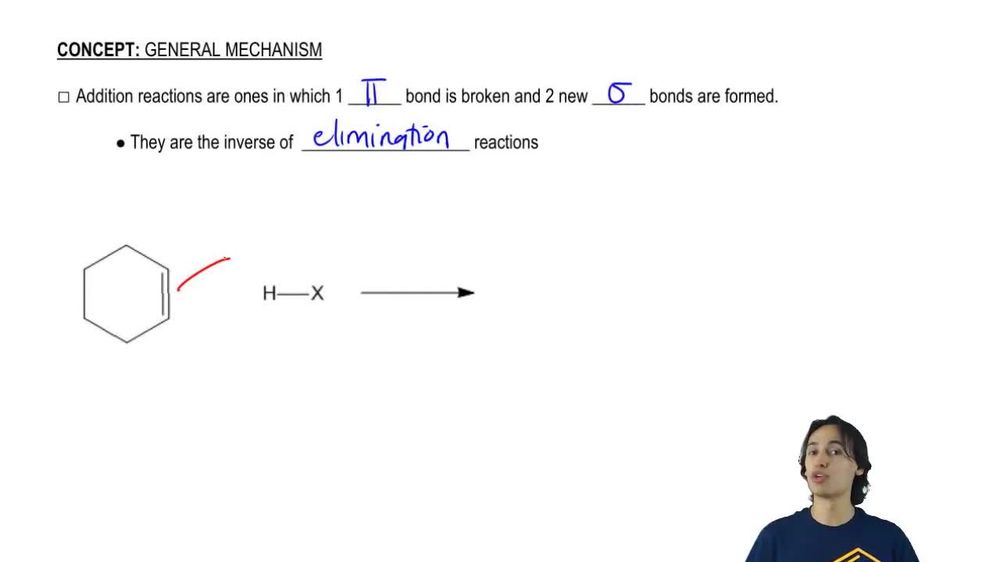
Recall the addition reactions of alkenes with halogens or hydrogen halides. These reactions typically involve the electrophilic addition mechanism, where the alkene reacts with a halogen or hydrogen halide to form a haloalkane.
For each haloalkane, identify the specific reagent needed. For example, if the haloalkane is a chloroalkane, the reagent could be HCl or Cl₂. If it's a bromoalkane, the reagent could be HBr or Br₂.
Write the chemical equations for each reaction, showing the conversion of the alkene to the haloalkane using the identified reagents. Use MathML to represent the chemical structures and equations clearly.
Verified video answer for a similar problem:
This video solution was recommended by our tutors as helpful for the problem above
Video duration:
1m
Play a video:
0 Comments
Key Concepts
Here are the essential concepts you must grasp in order to answer the question correctly.
Alkene Structure
Alkenes are hydrocarbons containing a carbon-carbon double bond, which is the site of reactivity in many organic reactions. Understanding the structure of alkenes, including the position and geometry of the double bond, is crucial for predicting the products of reactions involving alkenes.
Electrophilic addition is a key reaction mechanism for alkenes, where the double bond acts as a nucleophile and reacts with electrophiles. This mechanism is essential for converting alkenes into haloalkanes, as it involves the addition of halogens or hydrogen halides across the double bond.
Regioselectivity refers to the preference for the formation of one constitutional isomer over another in a chemical reaction. Markovnikov's Rule predicts that in the addition of HX to an alkene, the hydrogen atom will attach to the carbon with more hydrogen substituents, while the halide will attach to the carbon with fewer hydrogen substituents, guiding the formation of specific haloalkanes.