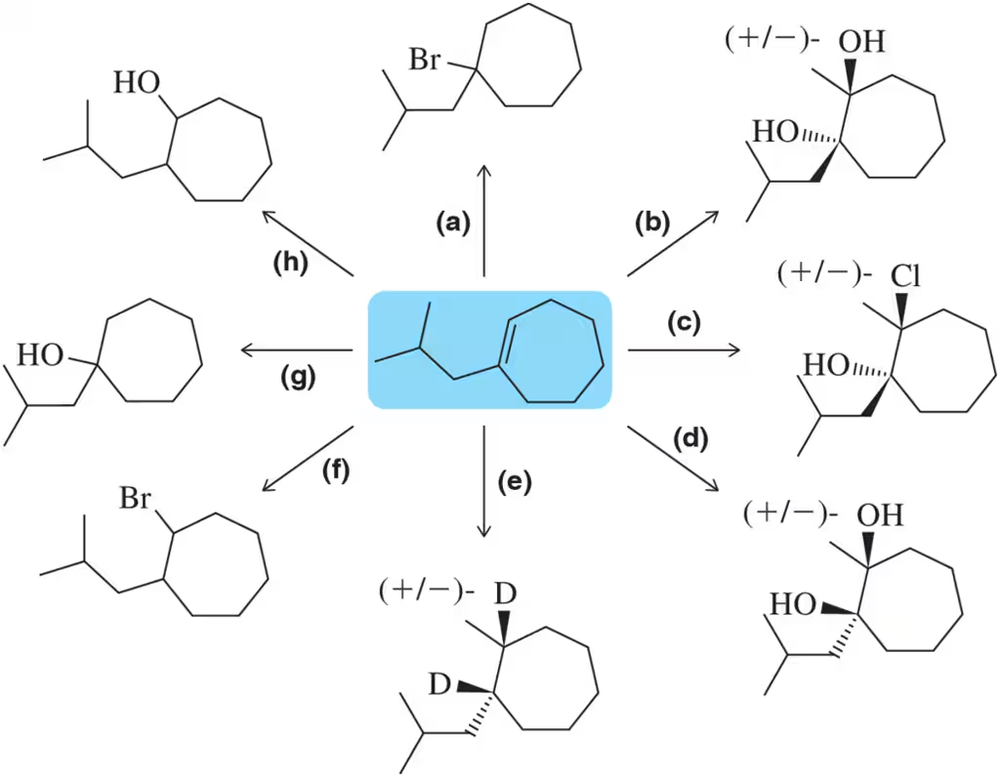
At the beginning of Chapter 9, we stated that after finishing Chapters 8 and 9, we would have the ability to make a large variety of functional groups using related reactions. Show the reagent(s) necessary to convert 1-isobutylcyclohexene into the following molecules. (a)
Verified step by step guidance
1
Analyze the structure of 1-isobutylcyclohexene. It contains a cyclohexene ring with a double bond and an isobutyl group attached to the ring. Identify the functional group transformations required for the target molecule.
Determine the type of reaction needed to modify the double bond in the cyclohexene ring. For example, if the target molecule requires an alcohol, consider hydroboration-oxidation or oxymercuration-demercuration.
If the target molecule involves oxidation or reduction, select the appropriate reagents. For example, to oxidize the double bond to an epoxide, use a peracid like mCPBA. To reduce the double bond, use hydrogen gas (H₂) with a metal catalyst like Pd/C.
If the isobutyl group needs to be modified, identify the necessary reagents. For example, if the target molecule requires oxidation of the isobutyl group to a carboxylic acid, use a strong oxidizing agent like KMnO₄ or CrO₃ under acidic conditions.
Combine the steps logically, ensuring that the reagents and reaction conditions are compatible with the functional groups present in the molecule. Write out the sequence of reactions and reagents required to achieve the transformation.
Verified video answer for a similar problem:
This video solution was recommended by our tutors as helpful for the problem above
Video duration:
1m
Play a video:
0 Comments
Key Concepts
Here are the essential concepts you must grasp in order to answer the question correctly.
Functional Groups
Functional groups are specific groups of atoms within molecules that are responsible for the characteristic chemical reactions of those molecules. Understanding functional groups is essential in organic chemistry as they dictate the reactivity and properties of compounds. Examples include hydroxyl (-OH), carboxyl (-COOH), and amine (-NH2) groups, each influencing how a molecule interacts with others.
Reagents are substances that are added to a system to cause a chemical reaction or to see if a reaction occurs. In organic chemistry, different reagents are used to facilitate transformations between functional groups. For instance, reagents like bromine (Br2) can be used for halogenation, while sulfuric acid (H2SO4) can promote dehydration reactions, making it crucial to select the appropriate reagent for the desired transformation.
A reaction mechanism is a step-by-step description of the process by which reactants are converted into products. Understanding mechanisms helps predict the outcome of reactions and the conditions required for them. Key concepts include nucleophiles and electrophiles, transition states, and intermediates, which are vital for comprehending how and why specific reagents lead to particular functional group transformations.