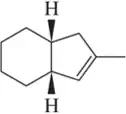
Predict the product(s) that would result when the alkenes shown here are allowed to react under the following conditions:(ii) HCl (k)
Verified step by step guidance
1
Identify the type of reaction: The reaction of an alkene with HCl is an electrophilic addition reaction. The π-electrons of the alkene act as a nucleophile and react with the electrophilic hydrogen (H⁺) from HCl.
Determine the regioselectivity: Use Markovnikov's rule to predict the major product. According to this rule, the hydrogen atom (H⁺) will add to the carbon of the double bond that has more hydrogen atoms already attached, while the chlorine (Cl⁻) will add to the carbon with fewer hydrogen atoms.
Draw the carbocation intermediate: After the addition of H⁺ to the alkene, a carbocation intermediate is formed. Ensure that you consider the stability of the carbocation. If possible, rearrangements (e.g., hydride or alkyl shifts) may occur to form a more stable carbocation.
Add the nucleophile: The chloride ion (Cl⁻) will attack the positively charged carbocation, forming the final product. Ensure that you show the correct connectivity in the product structure.
Verify the stereochemistry (if applicable): If the reaction generates a chiral center, consider whether the product will be a racemic mixture or if stereoselectivity is involved. For simple alkenes, this step may not be necessary.
Verified video answer for a similar problem:
This video solution was recommended by our tutors as helpful for the problem above
Video duration:
2m
Play a video:
0 Comments
Key Concepts
Here are the essential concepts you must grasp in order to answer the question correctly.
Electrophilic Addition
Electrophilic addition is a fundamental reaction mechanism in organic chemistry where an electrophile reacts with a nucleophile, typically involving alkenes. In the presence of HCl, the double bond of the alkene acts as a nucleophile, attacking the electrophilic hydrogen atom of HCl, leading to the formation of a carbocation intermediate. This process is crucial for predicting the products of alkene reactions.
Markovnikov's Rule states that in the addition of HX (where X is a halogen) to an alkene, the hydrogen atom will attach to the carbon with the greater number of hydrogen atoms already attached. This rule helps predict the regioselectivity of the reaction, guiding the formation of the more stable carbocation and ultimately the major product of the reaction when alkenes react with HCl.
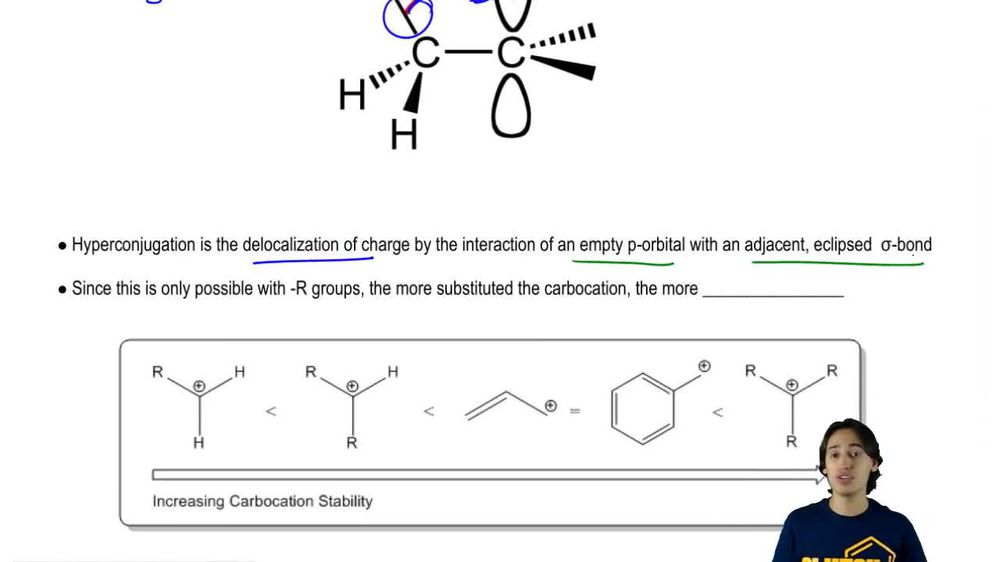
Carbocation stability is a key concept in organic chemistry that refers to the relative stability of positively charged carbon species. Carbocations are classified as primary, secondary, or tertiary based on the number of alkyl groups attached to the positively charged carbon. Tertiary carbocations are the most stable due to hyperconjugation and inductive effects, influencing the product distribution in reactions involving alkenes and HCl.