Draw the structure that corresponds with each name. e. 2,2,4,4-tetramethylhexane f. trans-1,3-diethylcyclopentane
Verified step by step guidance
1
To draw 2,2,4,4-tetramethylhexane, start by identifying the parent chain. The parent chain is 'hexane', which means it has 6 carbon atoms in a straight chain.
Next, identify the substituents. The name '2,2,4,4-tetramethyl' indicates that there are four methyl groups attached to the parent chain. Two methyl groups are attached to carbon 2, and two are attached to carbon 4.
Draw the hexane chain by arranging six carbon atoms in a linear sequence. Then, add the methyl groups: two on the second carbon and two on the fourth carbon.
For trans-1,3-diethylcyclopentane, start by drawing the cyclopentane ring, which is a five-membered carbon ring.
Identify the substituents: '1,3-diethyl' means there are ethyl groups attached to carbons 1 and 3. The 'trans' configuration indicates that these ethyl groups are on opposite sides of the cyclopentane ring. Draw the ethyl groups accordingly, ensuring they are on opposite sides of the plane of the ring.
Verified video answer for a similar problem:
This video solution was recommended by our tutors as helpful for the problem above
Video duration:
5m
Play a video:
0 Comments
Key Concepts
Here are the essential concepts you must grasp in order to answer the question correctly.
IUPAC Nomenclature
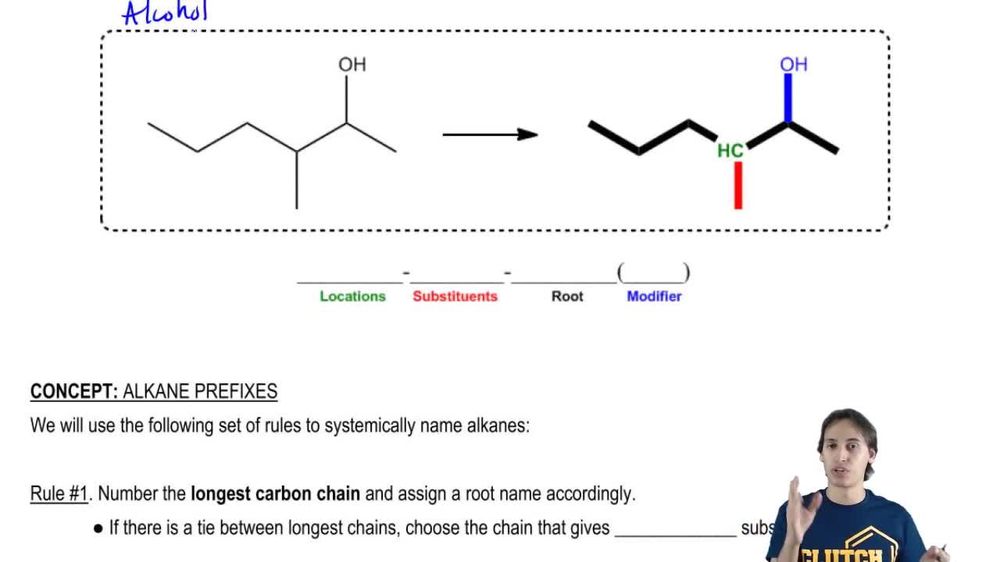
IUPAC nomenclature is a standardized system for naming chemical compounds. It involves identifying the longest carbon chain, numbering the chain to give substituents the lowest possible numbers, and naming substituents as prefixes. Understanding this system is crucial for interpreting and drawing structures from chemical names.
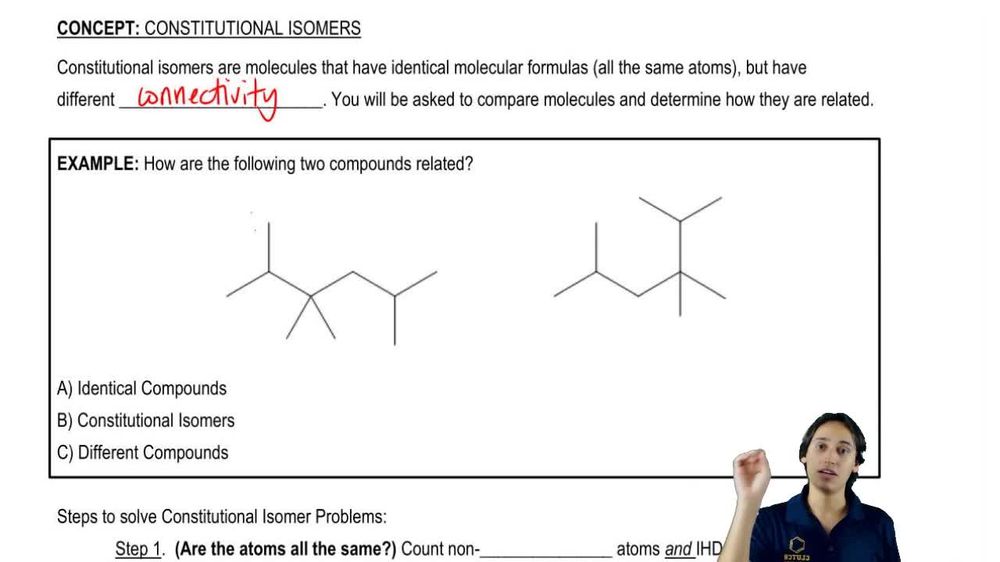
Structural isomers are compounds with the same molecular formula but different structural arrangements. In organic chemistry, recognizing how substituents can be arranged differently on a carbon skeleton is essential for drawing accurate structures, as seen in compounds like 2,2,4,4-tetramethylhexane.
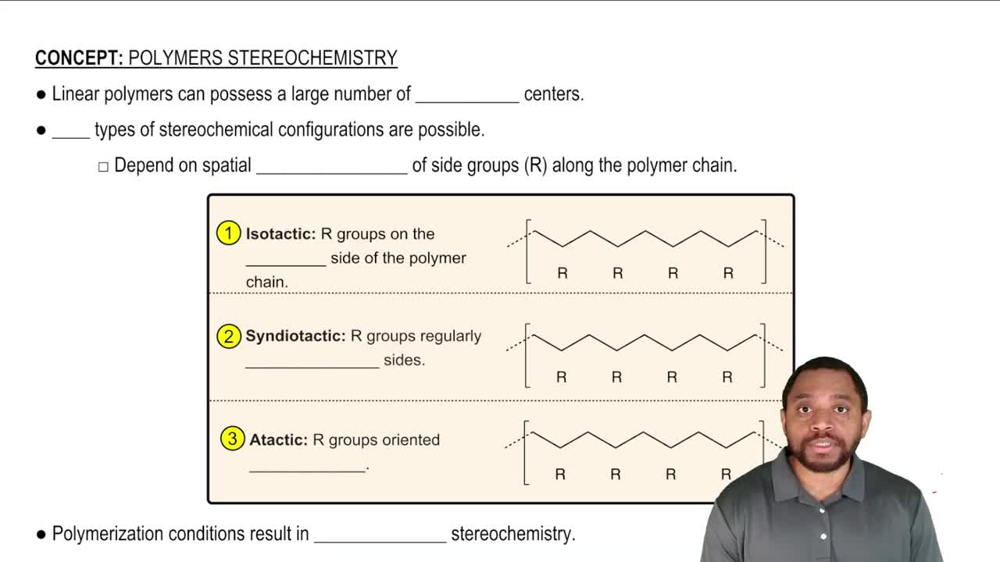
Stereochemistry involves the study of spatial arrangement of atoms in molecules. Terms like 'trans' indicate specific geometric configurations, where substituents are on opposite sides of a ring or double bond. Understanding stereochemistry is vital for accurately depicting molecules like trans-1,3-diethylcyclopentane.