Ch. 13 - Mass Spectrometry; Infrared Spectroscopy; UV/Vis Spectroscopy
Bruice - Organic Chemistry 8th Edition
Bruice8th EditionOrganic ChemistryISBN: 9780135213711Not the one you use?Change textbook
Chapter 14, Problem 8

Identify the hydrocarbon that has a molecular ion with an m/z value of 128, a base peak with an m/z value of 43, and significant peaks with m/z values of 57, 71, and 85.

Verified step by step guidance
1
Step 1: Understand the problem. The molecular ion peak (m/z = 128) represents the molecular weight of the hydrocarbon. The base peak (m/z = 43) is the most intense peak, often corresponding to a stable fragment. The other peaks (m/z = 57, 71, 85) represent additional fragments formed during mass spectrometry.
Step 2: Determine the molecular formula of the hydrocarbon. Since the molecular ion peak is 128, calculate the possible molecular formula by considering hydrocarbons (CnH2n+2 for alkanes, CnH2n for alkenes, etc.). Use the molecular weight to deduce the number of carbon and hydrogen atoms.
Step 3: Analyze the base peak (m/z = 43). This peak often corresponds to a common fragment such as a propyl group (C3H7+) or an isopropyl group. Consider how the hydrocarbon could fragment to produce this peak.
Step 4: Examine the other significant peaks (m/z = 57, 71, 85). These peaks suggest a series of alkyl fragments, likely resulting from the stepwise loss of CH2 groups. This pattern is characteristic of straight-chain or branched alkanes.
Step 5: Propose the structure of the hydrocarbon. Based on the molecular weight (128) and the fragmentation pattern, hypothesize a structure that matches the observed peaks. Verify that the structure can produce the given fragments during mass spectrometry.

Verified video answer for a similar problem:

This video solution was recommended by our tutors as helpful for the problem above.
Video duration:
13m
Was this helpful?

Key Concepts

Here are the essential concepts you must grasp in order to answer the question correctly.

Mass Spectrometry

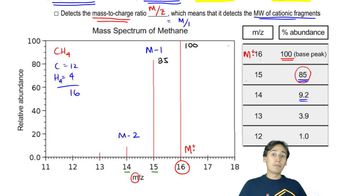
Mass spectrometry is an analytical technique used to measure the mass-to-charge ratio of ions. It helps in identifying the composition of a sample by generating a mass spectrum, which displays the relative abundance of ions at different m/z values. The molecular ion peak corresponds to the intact molecule, while fragment peaks indicate the breakdown of the molecule into smaller parts.
Recommended video:
Guided course
01:25
How to Read a Mass Spectrum

Molecular Ion (M+)

The molecular ion, often denoted as M+, represents the ionized form of the entire molecule without any fragmentation. Its m/z value indicates the molecular weight of the compound. In this question, the molecular ion with an m/z value of 128 suggests that the hydrocarbon has a molecular weight of 128 g/mol, which is crucial for identifying the compound.
Recommended video:
3:39
Metal Ion Catalysis Concept 1

Fragmentation Patterns

Fragmentation patterns refer to the specific ways in which a molecule breaks apart during ionization in mass spectrometry. Each fragment has its own m/z value, which can provide insights into the structure of the original molecule. The presence of significant peaks at m/z values of 43, 57, 71, and 85 indicates common fragmentation pathways, which can help deduce the molecular structure and functional groups present in the hydrocarbon.
Recommended video:
Guided course
08:06
Common Splitting Patterns