How many allylic substituted bromoalkenes are formed from the reactions in Problems 18 if stereoisomers are included?
Verified step by step guidance
1
Step 1: Analyze the reaction conditions. The reaction involves NBS (N-bromosuccinimide) in the presence of heat (Δ) and peroxide. This is a typical setup for allylic bromination, where bromine is introduced at the allylic position of an alkene.
Step 2: Identify the allylic positions in the given molecule. The molecule is cyclopentene, which has two allylic positions (the carbons adjacent to the double bond). These positions are equivalent due to the symmetry of the molecule.
Step 3: Consider the stereochemistry of the bromination. Bromination at the allylic position can lead to the formation of stereoisomers because the bromine atom can be added to either side of the planar allylic radical intermediate.
Step 4: Determine the possible products. Since the allylic positions are equivalent, bromination at either position will yield the same set of products. However, the stereoisomers arise due to the different spatial arrangements of the bromine atom relative to the double bond.
Step 5: Count the number of stereoisomers. For each allylic position, two stereoisomers (E and Z configurations) can be formed due to the double bond geometry. Since the allylic positions are equivalent, the total number of allylic substituted bromoalkenes formed, including stereoisomers, is the sum of these possibilities.
Verified video answer for a similar problem:
This video solution was recommended by our tutors as helpful for the problem above
Video duration:
5m
Play a video:
0 Comments
Key Concepts
Here are the essential concepts you must grasp in order to answer the question correctly.
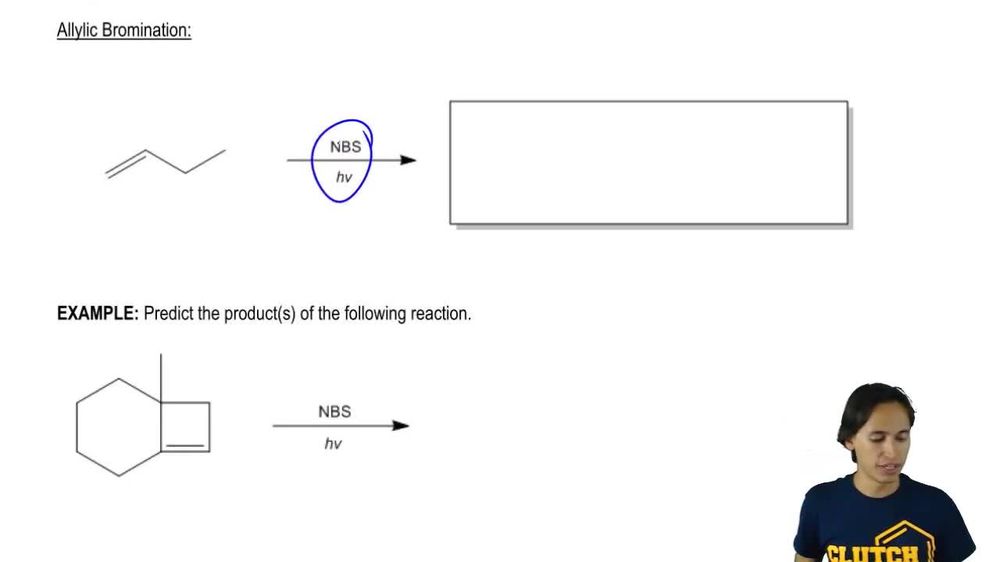
Allylic Bromination
Allylic bromination is a reaction where bromine is added to the allylic position of an alkene, typically using N-bromosuccinimide (NBS) in the presence of a radical initiator like peroxide. This reaction proceeds via a radical mechanism, where the allylic hydrogen is abstracted, forming a resonance-stabilized radical that can then react with bromine to form bromoalkenes.
Stereoisomerism refers to the phenomenon where compounds have the same molecular formula and connectivity but differ in the spatial arrangement of atoms. In the context of allylic bromination, the formation of stereoisomers occurs due to the presence of chiral centers or double bonds, leading to different geometric configurations (cis/trans or E/Z) in the resulting bromoalkenes.
A radical mechanism involves the formation and reaction of free radicals, which are highly reactive species with unpaired electrons. In allylic bromination, the initiation step generates radicals that facilitate the bromination process. Understanding this mechanism is crucial for predicting the products and their stereochemistry, as radicals can lead to multiple pathways and product distributions.

 5:16 minutes
 Verified step by step guidance
 00:54
00:54