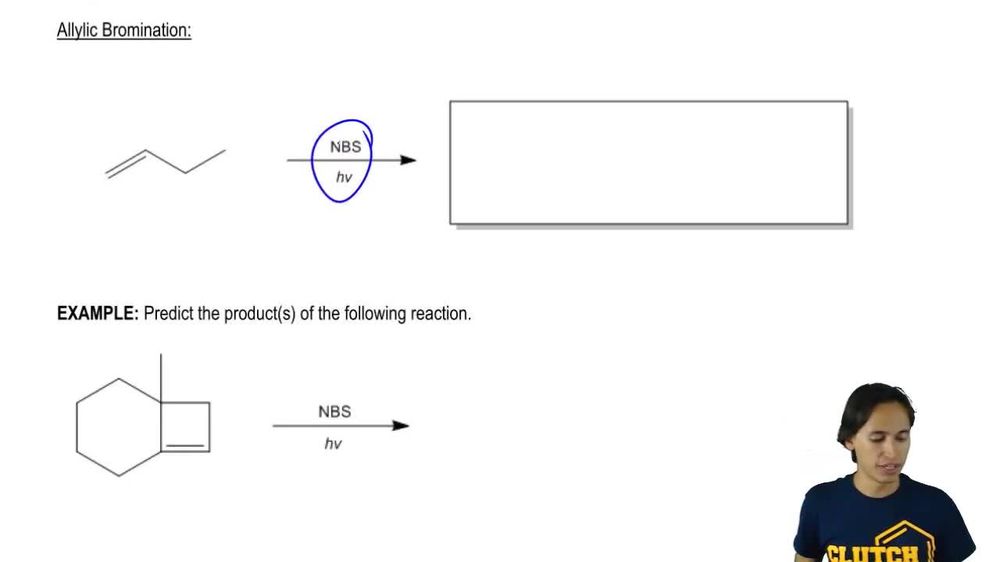
How many allylic substituted bromoalkenes are formed from the reactions in Problems 17 if stereoisomers are included?
Verified step by step guidance
1
Step 1: Analyze the given reaction conditions. The reaction involves NBS (N-bromosuccinimide) in the presence of heat (Δ) and peroxide. This is a radical bromination reaction that selectively brominates allylic positions in alkenes.
Step 2: Identify the allylic positions in the given molecule. Allylic positions are the carbon atoms adjacent to the double bond. In the provided structure, there are two allylic positions on either side of the double bond.
Step 3: Consider the possible products formed by bromination at each allylic position. Bromination at each allylic position can lead to different regioisomers, depending on which allylic hydrogen is replaced by bromine.
Step 4: Account for stereoisomers. Since the allylic carbons are sp3 hybridized, bromination can lead to stereoisomers (R and S configurations) at each brominated position. This increases the number of possible products.
Step 5: Combine regioisomeric and stereoisomeric possibilities. For each allylic position, consider the number of stereoisomers formed. Add these together to determine the total number of allylic substituted bromoalkenes formed.
Verified video answer for a similar problem:
This video solution was recommended by our tutors as helpful for the problem above
Video duration:
4m
Play a video:
0 Comments
Key Concepts
Here are the essential concepts you must grasp in order to answer the question correctly.
Allylic Substitution
Allylic substitution refers to the replacement of a hydrogen atom at the allylic position (the carbon adjacent to a double bond) with another atom or group. This reaction is significant in organic chemistry as it allows for the formation of new compounds with varied properties. The presence of a double bond influences the reactivity and stability of the intermediates formed during the reaction.
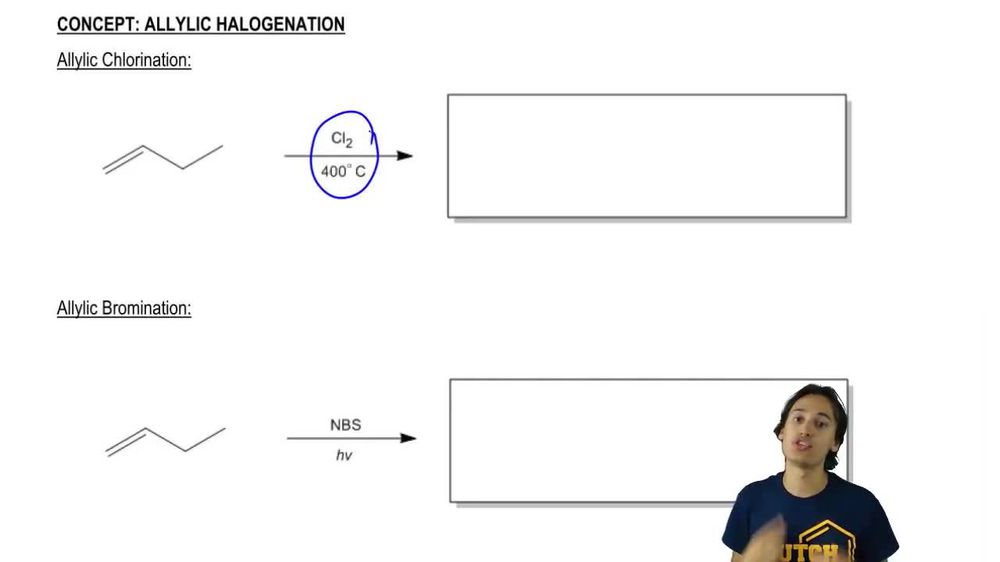
N-Bromosuccinimide (NBS) is a reagent commonly used for allylic bromination. It generates bromine radicals under specific conditions, such as heat or light, which can abstract hydrogen atoms from the allylic position, leading to the formation of allylic bromides. This method is advantageous because it selectively brominates the allylic position while minimizing the formation of other byproducts.
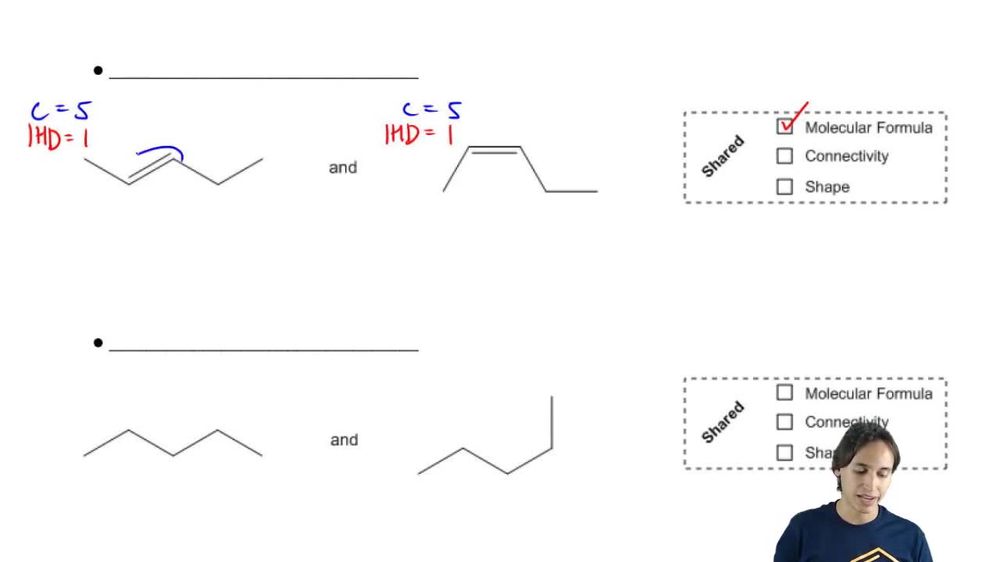
Stereoisomerism occurs when compounds have the same molecular formula and connectivity but differ in the spatial arrangement of their atoms. In the context of allylic bromination, the formation of stereoisomers is crucial as different configurations (cis/trans or E/Z) can arise from the reaction. Understanding stereoisomerism is essential for predicting the number of distinct products formed in a reaction, especially when multiple chiral centers are involved.

 4:53 minutes
 Verified step by step guidance
 00:48
00:48