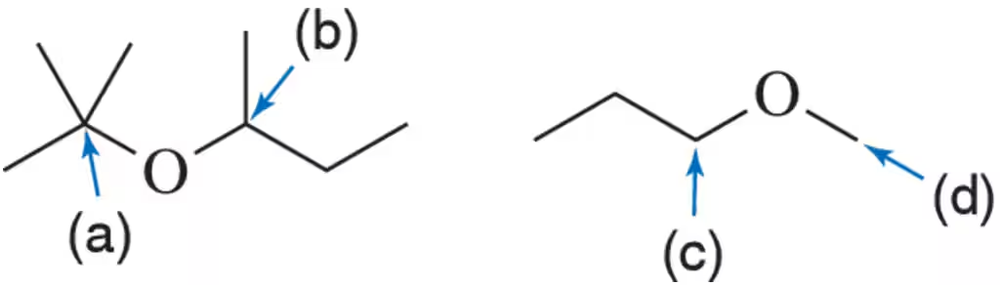
Identify the substitution of carbons (a)–(d) comprising the ether functional group in the following molecules.
Verified step by step guidance
1
Understand the ether functional group: An ether is characterized by an oxygen atom connected to two alkyl or aryl groups. The general structure is R-O-R', where R and R' are carbon-containing groups.
Identify the carbon atoms directly attached to the oxygen atom in the ether functional group. These are the carbons whose substitution needs to be determined.
Determine the substitution level of each carbon atom. In organic chemistry, carbon atoms can be classified based on the number of other carbon atoms they are attached to: primary (1°), secondary (2°), tertiary (3°), or quaternary (4°).
For each carbon atom (a)–(d), count the number of carbon atoms directly attached to it. This will help you classify each carbon as primary, secondary, tertiary, or quaternary.
Once you have identified the substitution level for each carbon atom, you can describe them as primary, secondary, tertiary, or quaternary based on the number of carbon connections.
Verified video answer for a similar problem:
This video solution was recommended by our tutors as helpful for the problem above
Video duration:
3m
Play a video:
0 Comments
Key Concepts
Here are the essential concepts you must grasp in order to answer the question correctly.
Ether Functional Group
An ether functional group consists of an oxygen atom connected to two alkyl or aryl groups. It is represented by the general formula R-O-R', where R and R' are carbon-containing groups. Understanding the structure of ethers is crucial for identifying the substitution pattern of carbons in molecules containing this functional group.
Carbon substitution refers to the number and type of groups attached to a carbon atom. In organic chemistry, carbons can be classified as primary, secondary, tertiary, or quaternary based on the number of carbon atoms directly bonded to them. This classification helps in understanding the reactivity and properties of the molecule.
Analyzing molecular structure involves examining the arrangement of atoms within a molecule to determine functional groups and substitution patterns. This requires understanding chemical bonding and spatial orientation, which are essential for identifying specific features like the ether group and the substitution of carbons in complex molecules.