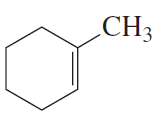
How many carbons are in the planar double-bond system in the following compound?
Verified step by step guidance
1
Step 1: Identify the double bond in the given compound. In the provided structure, there is one double bond present within the five-membered ring.
Step 2: Recognize that a planar double-bond system involves sp2 hybridized carbons. These carbons are part of the double bond and are in a trigonal planar geometry.
Step 3: Examine the structure to determine which carbons are directly involved in the double bond. In this case, two carbons are part of the double bond within the ring.
Step 4: Check if there are any additional conjugated systems or resonance structures that extend the planar system. In this compound, there are no additional conjugated systems; the planar system is limited to the two carbons in the double bond.
Step 5: Conclude that the planar double-bond system in this compound consists of two carbons, as only the two sp2 hybridized carbons in the double bond are part of the planar system.
Verified video answer for a similar problem:
This video solution was recommended by our tutors as helpful for the problem above
Video duration:
2m
Play a video:
0 Comments
Key Concepts
Here are the essential concepts you must grasp in order to answer the question correctly.
Planar Double-Bond System
A planar double-bond system refers to a molecular structure where two carbon atoms are connected by a double bond, and the atoms involved lie in the same plane. This configuration allows for the possibility of geometric isomerism, where the spatial arrangement of substituents around the double bond can vary, affecting the compound's properties.
Counting carbons in organic compounds involves identifying each carbon atom present in the molecular structure. In cyclic compounds, such as rings, each vertex typically represents a carbon atom, and any explicit carbon atoms in substituents must also be included in the total count.
Cyclic structures are closed-loop arrangements of atoms, commonly found in organic chemistry. These structures can be aliphatic or aromatic and often influence the chemical reactivity and stability of the compound. Understanding the nature of these cycles is crucial for analyzing the overall structure and behavior of the molecule.