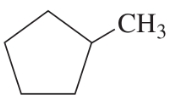
Label each hydrogen atom in the following compounds as primary (1°), secondary (2°), or tertiary (3°). (c) (CH3)2CHCH(CH3)CH2CH3 (d)
Verified step by step guidance
1
Step 1: Understand the definitions of primary, secondary, and tertiary hydrogen atoms. A primary hydrogen is attached to a primary carbon (a carbon bonded to only one other carbon). A secondary hydrogen is attached to a secondary carbon (a carbon bonded to two other carbons). A tertiary hydrogen is attached to a tertiary carbon (a carbon bonded to three other carbons).
Step 2: Analyze the structure of the compound (CH3)2CHCH(CH3)CH2CH3. Break down the structure to identify each carbon atom and its connectivity. The structure can be visualized as: CH3-CH(CH3)-CH(CH3)-CH2-CH3.
Step 3: Label the hydrogen atoms on each carbon. Start with the first carbon (CH3 group), which is a primary carbon, so all hydrogens here are primary hydrogens.
Step 4: Move to the second carbon (CH), which is bonded to three other carbons, making it a tertiary carbon. Therefore, the hydrogen attached to this carbon is a tertiary hydrogen.
Step 5: Continue to the third carbon (CH), which is bonded to two other carbons, making it a secondary carbon. Thus, the hydrogen attached to this carbon is a secondary hydrogen. Finally, the fourth carbon (CH2) is bonded to two other carbons, making it a secondary carbon, so the hydrogens here are secondary hydrogens.
Verified video answer for a similar problem:
This video solution was recommended by our tutors as helpful for the problem above
Video duration:
5m
Play a video:
0 Comments
Key Concepts
Here are the essential concepts you must grasp in order to answer the question correctly.
Hydrogen Atom Classification
In organic chemistry, hydrogen atoms are classified based on the type of carbon atom they are attached to. A primary (1°) hydrogen is attached to a carbon bonded to only one other carbon, a secondary (2°) hydrogen is attached to a carbon bonded to two other carbons, and a tertiary (3°) hydrogen is attached to a carbon bonded to three other carbons. This classification helps in understanding the reactivity and properties of different hydrogen atoms in a molecule.
Carbon atoms in organic molecules are classified as primary, secondary, tertiary, or quaternary based on the number of other carbon atoms they are directly bonded to. A primary carbon is bonded to one other carbon, a secondary to two, a tertiary to three, and a quaternary to four. This classification is crucial for determining the structure and reactivity of organic compounds, especially in reactions like substitution and elimination.
The difference between atomic numbers and atomic mass.
Structural Formula Interpretation
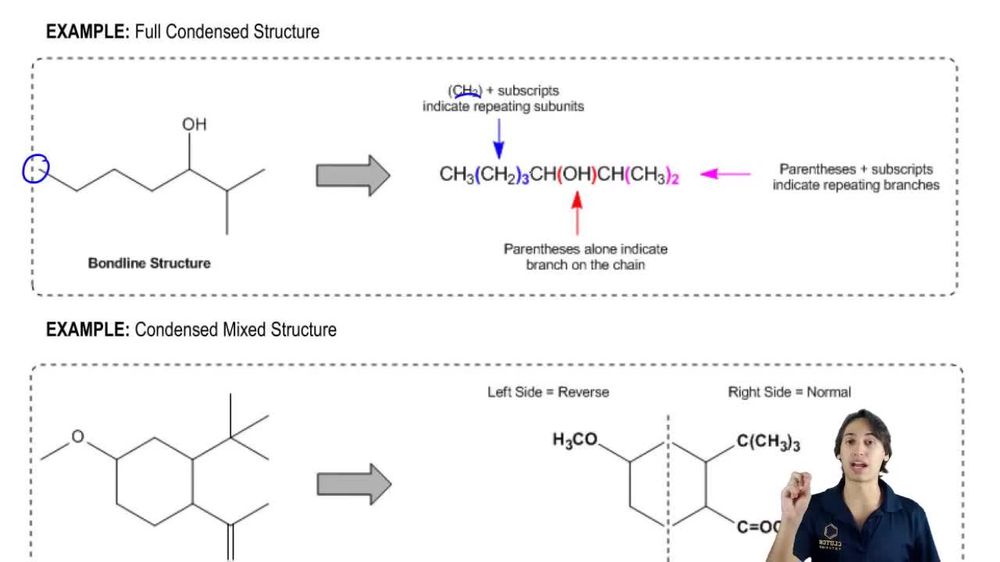
Understanding structural formulas is essential for identifying the connectivity and arrangement of atoms within a molecule. In the given compound (CH3)2CHCH(CH3)CH2CH3, each group represents a specific arrangement of carbon and hydrogen atoms. Interpreting these groups allows for the identification of primary, secondary, and tertiary hydrogens by analyzing the carbon framework and its connectivity, which is fundamental for solving the problem.