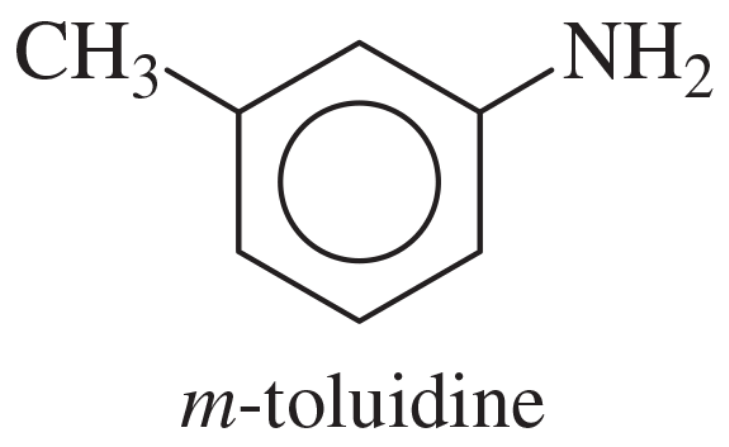
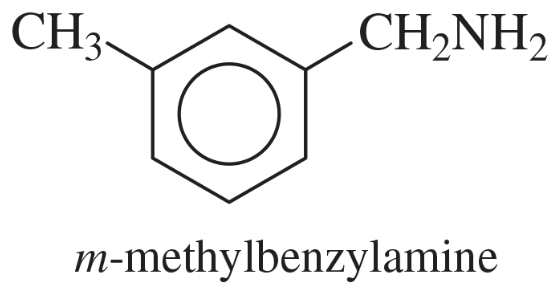
Show how m-toluidine can be converted to the following compounds, using any necessary reagents. (b)
Verified step by step guidance
1
Step 1: Begin with m-toluidine (C6H4CH3NH2), which contains an amino group (-NH2) and a methyl group (-CH3) attached to a benzene ring in the meta position. Identify the target compound and determine the functional group transformations required.
Step 2: Protect the amino group (-NH2) to prevent unwanted reactions during subsequent steps. This can be achieved by acetylation using acetic anhydride (CH3CO)2O, forming an acetamide (-NHCOCH3). This step ensures selective reactivity of the methyl group.
Step 3: Oxidize the methyl group (-CH3) to a carboxylic acid (-COOH). This can be done using a strong oxidizing agent such as potassium permanganate (KMnO4) or chromic acid (H2CrO4). The methyl group is converted to a benzoic acid derivative.
Step 4: Remove the protecting group from the amino group (-NHCOCH3) to regenerate the free amino group (-NH2). This can be achieved by hydrolysis using either acidic or basic conditions, such as HCl or NaOH.
Step 5: Verify the structure of the final compound to ensure that the desired functional groups are correctly positioned and the transformations are complete. The final product should have a carboxylic acid (-COOH) and an amino group (-NH2) in the meta positions relative to each other on the benzene ring.
Verified video answer for a similar problem:
This video solution was recommended by our tutors as helpful for the problem above
Video duration:
6m
Play a video:
0 Comments
Key Concepts
Here are the essential concepts you must grasp in order to answer the question correctly.
Amines and Their Reactivity
Amines are organic compounds derived from ammonia by replacing one or more hydrogen atoms with alkyl or aryl groups. They can act as nucleophiles due to the lone pair of electrons on the nitrogen atom, making them reactive in various organic reactions, including alkylation and acylation. Understanding the reactivity of amines is crucial for predicting the products of reactions involving m-toluidine.
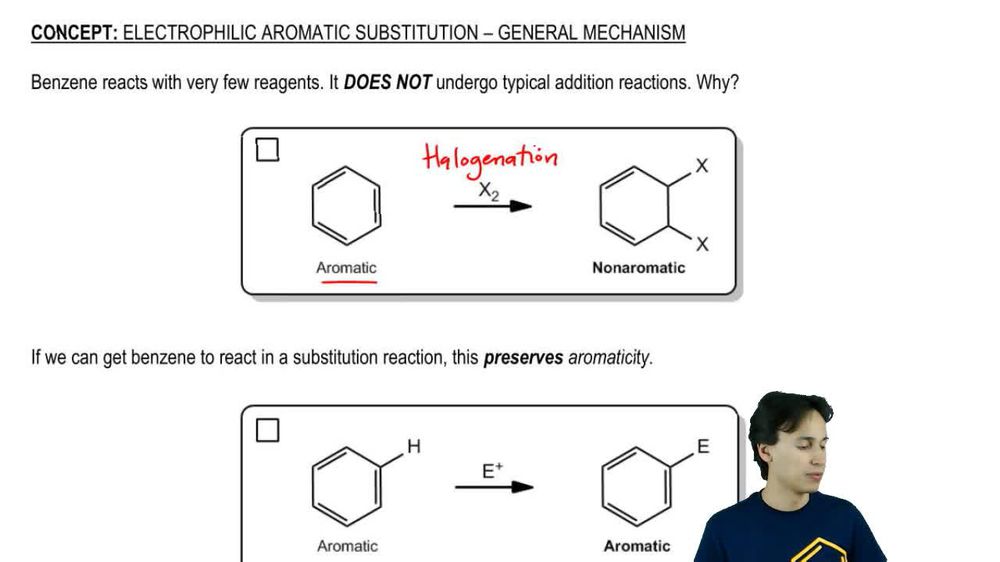
Electrophilic Aromatic Substitution is a fundamental reaction in organic chemistry where an electrophile replaces a hydrogen atom on an aromatic ring. In the case of m-toluidine, the amino group (-NH2) is an activating group that directs electrophiles to the ortho and para positions of the aromatic ring. This concept is essential for understanding how to modify the aromatic structure of m-toluidine to form desired products.
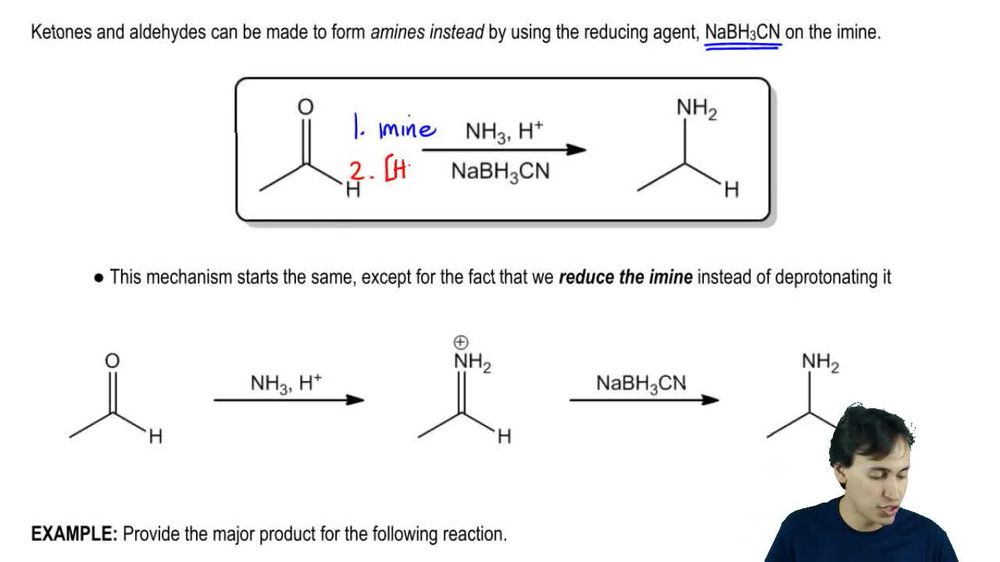
Reduction reactions involve the gain of electrons or the decrease in oxidation state of a molecule. In organic chemistry, this often refers to the conversion of functional groups, such as the reduction of nitro groups to amines or the reduction of carbonyls to alcohols. Knowing the types of reducing agents and their mechanisms is vital for transforming m-toluidine into other compounds, especially when considering the functional groups present in the target products.