Would the following nucleophiles be more likely to participate in an SN1 or SN2 reaction? (f)
Verified step by step guidance
1
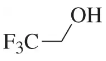
Step 1: Analyze the structure of the nucleophile provided. The nucleophile is CF₃CH₂OH, which contains a hydroxyl (-OH) group attached to a carbon that is adjacent to a trifluoromethyl group (-CF₃). The trifluoromethyl group is highly electronegative and exerts an electron-withdrawing effect.
Step 2: Consider the electron-withdrawing effect of the -CF₃ group. This effect reduces the nucleophilicity of the hydroxyl group because the electron density on the oxygen atom is pulled away, making it less reactive as a nucleophile.
Step 3: Evaluate the reaction mechanism preference. SN2 reactions require strong nucleophiles and occur in a single step with backside attack. The reduced nucleophilicity of CF₃CH₂OH makes it less favorable for SN2 reactions. On the other hand, SN1 reactions involve the formation of a carbocation intermediate, which is stabilized by electron-withdrawing groups.
Step 4: Assess the stability of the carbocation intermediate. In an SN1 reaction, the electron-withdrawing -CF₃ group destabilizes the carbocation intermediate because it pulls electron density away from the positively charged carbon. This makes SN1 less favorable for this nucleophile.
Step 5: Conclude the likely reaction type. Given the reduced nucleophilicity and the destabilization of the carbocation intermediate, CF₃CH₂OH is not strongly suited for either SN1 or SN2 reactions. However, if forced to choose, it may lean slightly toward SN2 due to the lack of carbocation stabilization required for SN1.
Verified video answer for a similar problem:
This video solution was recommended by our tutors as helpful for the problem above
Play a video:
0 Comments
Key Concepts
Here are the essential concepts you must grasp in order to answer the question correctly.
Nucleophilicity
Nucleophilicity refers to the ability of a nucleophile to donate an electron pair to an electrophile during a chemical reaction. Stronger nucleophiles are more reactive and can participate in both Sₙ1 and Sₙ2 reactions. Factors influencing nucleophilicity include charge, electronegativity, and solvent effects, with stronger bases typically being better nucleophiles.
Sₙ1 (unimolecular nucleophilic substitution) and Sₙ2 (bimolecular nucleophilic substitution) are two fundamental mechanisms of nucleophilic substitution reactions. Sₙ1 involves a two-step process where the leaving group departs first, forming a carbocation intermediate, while Sₙ2 is a one-step process where the nucleophile attacks the substrate simultaneously as the leaving group departs. The choice between these mechanisms depends on factors like substrate structure and nucleophile strength.
The structure of the substrate plays a crucial role in determining whether an Sₙ1 or Sₙ2 reaction will occur. Tertiary substrates favor Sₙ1 due to the stability of the carbocation formed, while primary substrates are more likely to undergo Sₙ2 reactions because they can accommodate a backside attack by the nucleophile. Secondary substrates can lead to either mechanism depending on the conditions and nucleophile involved.

 Verified step by step guidance
 08:27
08:27