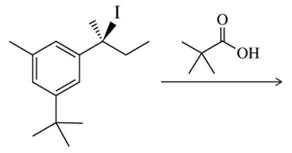
Predict the product of the following substitution reactions, paying close attention to the stereochemical outcome of the reactions. (e)
Verified step by step guidance
1
Analyze the given reactants: The starting material is an aryl iodide with a stereocenter, and the reagent is a carboxylic acid (specifically, 2,2-dimethylpropanoic acid). This suggests a substitution reaction involving the iodine atom.
Determine the reaction mechanism: The presence of a carboxylic acid indicates that the reaction may proceed via an SN1 mechanism due to the stability of the benzylic carbocation formed after the departure of the iodine atom. Benzylic carbocations are stabilized by resonance with the aromatic ring.
Consider stereochemical implications: In an SN1 reaction, the carbocation intermediate is planar, allowing for nucleophilic attack from either side. This results in a racemic mixture if the stereocenter is involved in the reaction.
Predict the nucleophile's role: The carboxylic acid can act as a nucleophile, attacking the carbocation to form an ester bond. The bulky nature of the carboxylic acid may influence the stereochemical outcome slightly, but the reaction is still expected to yield a mixture of stereoisomers.
Write the product structure: The product will be an ester where the benzylic position is bonded to the oxygen atom of the carboxylic acid. The stereochemistry at the benzylic position will be a racemic mixture due to the planar nature of the carbocation intermediate.
Verified video answer for a similar problem:
This video solution was recommended by our tutors as helpful for the problem above
Play a video:
0 Comments
Key Concepts
Here are the essential concepts you must grasp in order to answer the question correctly.
Nucleophilic Substitution Reactions
Nucleophilic substitution reactions involve the replacement of a leaving group in a molecule by a nucleophile. These reactions can occur via two main mechanisms: SN1 and SN2. The SN1 mechanism is a two-step process where the leaving group departs first, forming a carbocation, followed by nucleophilic attack. In contrast, the SN2 mechanism is a one-step process where the nucleophile attacks the substrate simultaneously as the leaving group departs, leading to a concerted reaction.
Nucleophiles and Electrophiles can react in Substitution Reactions.
Stereochemistry
Stereochemistry refers to the study of the spatial arrangement of atoms in molecules and how this affects their chemical behavior. In substitution reactions, the stereochemical outcome is crucial, especially in SN2 reactions, which result in inversion of configuration at the chiral center. Understanding stereochemistry is essential for predicting the three-dimensional orientation of the product and its potential biological activity.
Leaving groups are atoms or groups that can depart from the parent molecule during a chemical reaction, facilitating nucleophilic substitution. A good leaving group is typically stable after departure, such as halides (e.g., Cl, Br, I) or sulfonate groups. The nature of the leaving group significantly influences the reaction rate and mechanism, making it a critical factor in predicting the products of substitution reactions.

 Verified step by step guidance
 01:47
01:47