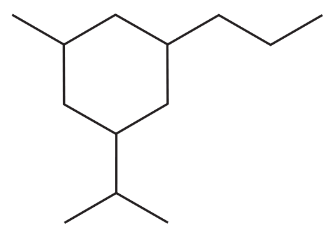
a. How many primary carbons does each of the following compounds have? b. How many secondary carbons does each one have? c. How many tertiary carbons does each one have? 2.
Verified step by step guidance
1
Step 1: Identify the primary carbons in the compound. Primary carbons are those attached to only one other carbon atom. Look for terminal carbons or carbons bonded to a single carbon atom.
Step 2: Count the secondary carbons in the compound. Secondary carbons are attached to two other carbon atoms. Examine the structure and locate carbons bonded to exactly two other carbons.
Step 3: Determine the tertiary carbons in the compound. Tertiary carbons are attached to three other carbon atoms. Look for carbons bonded to three other carbons in the structure.
Step 4: Analyze the structure systematically, starting from one end of the molecule and moving through each branch to ensure all carbons are accounted for.
Step 5: Summarize the counts of primary, secondary, and tertiary carbons based on the analysis of the structure.
Verified video answer for a similar problem:
This video solution was recommended by our tutors as helpful for the problem above
Play a video:
0 Comments
Key Concepts
Here are the essential concepts you must grasp in order to answer the question correctly.
Primary, Secondary, and Tertiary Carbons
In organic chemistry, carbons are classified based on the number of other carbon atoms they are directly bonded to. A primary carbon is attached to one other carbon, a secondary carbon to two, and a tertiary carbon to three. This classification is crucial for understanding the structure and reactivity of organic compounds.
Organic compounds can be represented in various structural forms, such as Lewis structures, condensed formulas, or skeletal structures. These representations help visualize the arrangement of atoms and bonds, which is essential for identifying the types of carbons present in a molecule.
To determine the number of primary, secondary, and tertiary carbons in a compound, one must analyze its structure carefully. This involves identifying each carbon atom and assessing its connectivity to other carbons, which can be facilitated by drawing out the structure or using molecular models.

 Verified step by step guidance
 2:07
2:07