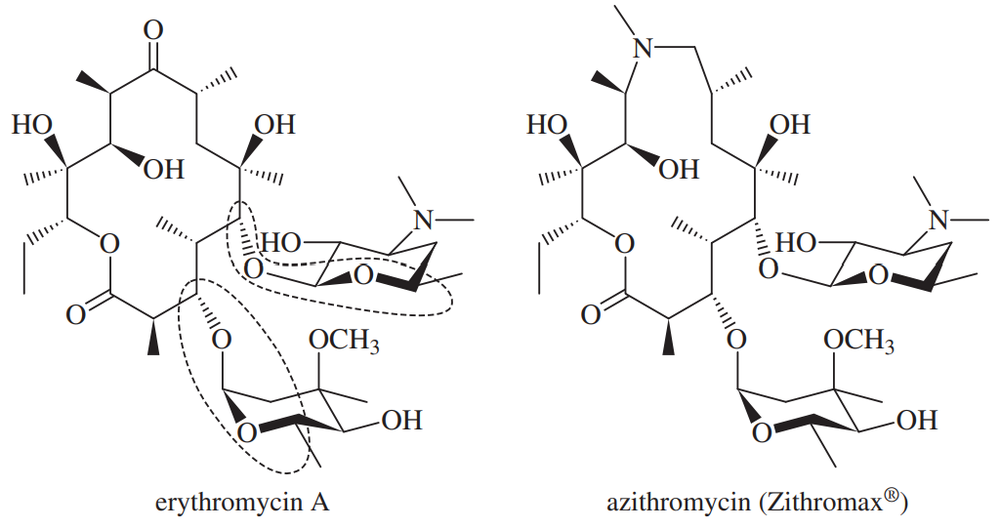
Macrolide antibiotics all have large rings (macrocycle) in which an ester makes the ring; a cyclic ester is termed a lactone. One example is erythromycin A, first isolated from soil bacteria in the 1950s. Over time, some pathogenic bacteria have developed resistance to erythromycin by evolving an enzymatic mechanism to cleave the macrocycle at the ketone. To counter this resistance, chemists modified the erythromycin structure to replace the ketone with an amine that the bacteria could not detoxify. This modified antibiotic, azithromycin, trade name Zithromax®, is one of the most prescribed drugs in the world for respiratory infections. (c) Identify the ketone in erythromycin targeted by bacteria as the site for detoxification. (d) Identify the amine in azithromycin. What type of amine is it?
Verified step by step guidance
1
Examine the structure of erythromycin A. Look for a carbonyl group (C=O) within the macrocyclic ring, as this is the ketone targeted by bacteria.
In the erythromycin A structure, identify the ketone group. It is located at the top of the macrocyclic ring, where a carbon atom is double-bonded to an oxygen atom.
Now, examine the structure of azithromycin. Look for an amine group, which is a nitrogen atom bonded to one or more alkyl or aryl groups.
In the azithromycin structure, identify the amine group. It is located at the top of the macrocyclic ring, where a nitrogen atom is bonded to two methyl groups.
Determine the type of amine in azithromycin. Since the nitrogen is bonded to two carbon atoms (methyl groups) and one hydrogen atom, it is a secondary amine.
Verified video answer for a similar problem:
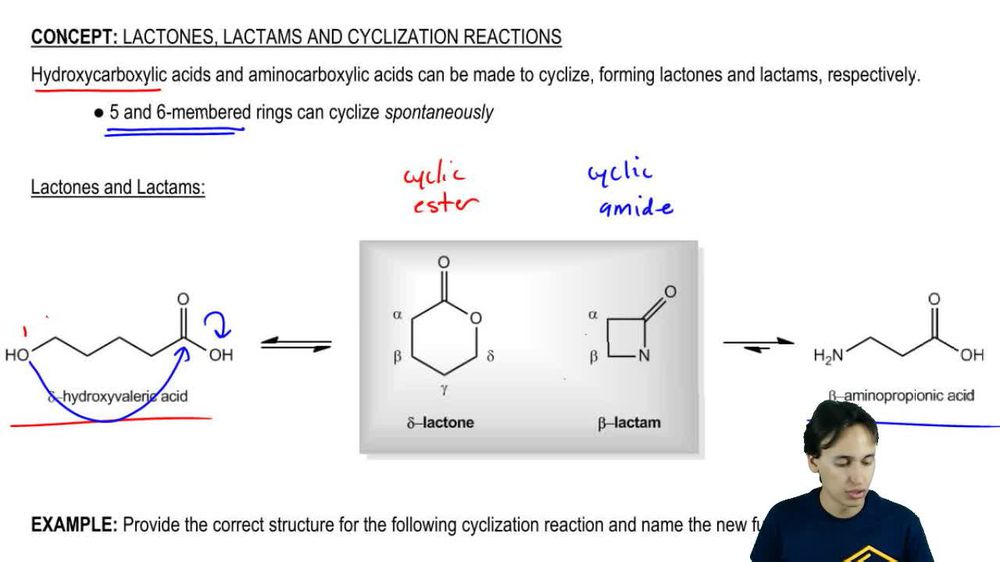
This video solution was recommended by our tutors as helpful for the problem above
Video duration:
5m
Play a video:
0 Comments
Key Concepts
Here are the essential concepts you must grasp in order to answer the question correctly.
Macrolide Antibiotics
Macrolide antibiotics are a class of antibiotics characterized by their large macrocyclic lactone ring structure. They are effective against a variety of bacterial infections by inhibiting protein synthesis. Erythromycin is a well-known example, and its structure includes a ketone that can be targeted by bacterial resistance mechanisms.
Ketones are organic compounds containing a carbonyl group (C=O) bonded to two carbon atoms, while amines are derivatives of ammonia (NH3) where one or more hydrogen atoms are replaced by alkyl or aryl groups. In the context of erythromycin and azithromycin, the ketone in erythromycin is the target for bacterial detoxification, while the amine in azithromycin serves as a modification to evade this resistance.
Bacterial resistance mechanisms refer to the various strategies that bacteria develop to survive exposure to antibiotics. In the case of erythromycin, bacteria evolved an enzymatic mechanism to cleave the macrocycle at the ketone, rendering the antibiotic ineffective. Understanding these mechanisms is crucial for developing new antibiotics, such as azithromycin, which incorporates structural changes to avoid being targeted.