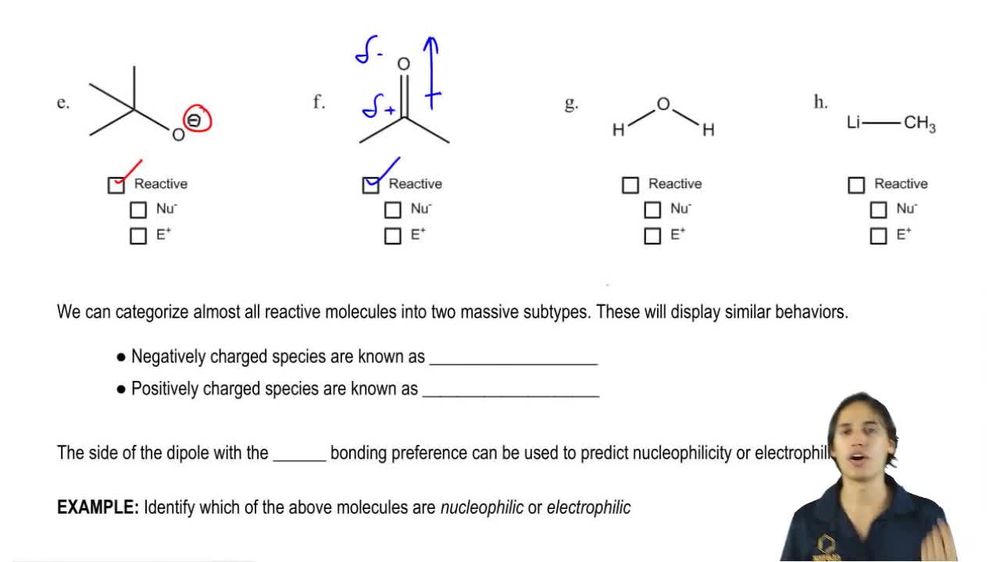
Would you expect the following species to be electrophiles or nucleophiles? Some may be both. Explain your answer. (e)
Verified step by step guidance
1
Step 1: Analyze the structure provided in the image. The species shown is a carbocation, specifically a secondary carbocation due to the positively charged carbon atom being attached to two other carbon atoms.
Step 2: Recall the definition of electrophiles and nucleophiles. Electrophiles are electron-deficient species that seek electrons, while nucleophiles are electron-rich species that donate electrons.
Step 3: Consider the electronic nature of the carbocation. The positively charged carbon atom indicates electron deficiency, making the species highly electrophilic as it seeks electrons to stabilize its charge.
Step 4: Evaluate whether the species could act as a nucleophile. Since the carbocation lacks electron density and does not have lone pairs or π-electrons to donate, it cannot act as a nucleophile.
Step 5: Conclude that the given species is an electrophile due to its electron-deficient nature and inability to donate electrons.
Verified video answer for a similar problem:
This video solution was recommended by our tutors as helpful for the problem above
Play a video:
0 Comments
Key Concepts
Here are the essential concepts you must grasp in order to answer the question correctly.
Electrophiles
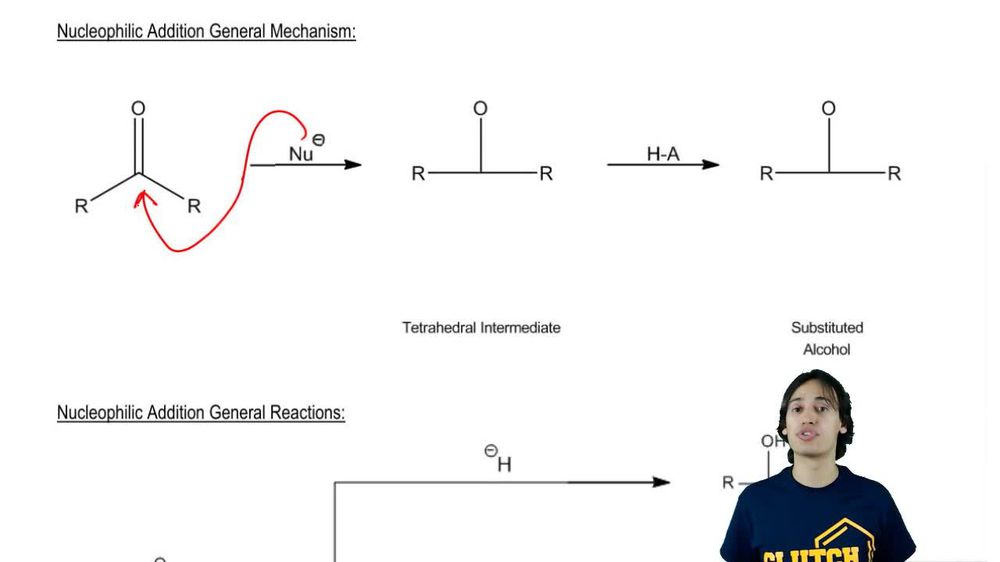
Electrophiles are species that are electron-deficient and seek to gain electrons by reacting with nucleophiles. They typically have a positive charge or a partial positive charge due to electronegative atoms or groups that withdraw electron density. In organic reactions, electrophiles are often involved in addition or substitution reactions, where they accept electron pairs from nucleophiles.
Nucleophiles are species that are electron-rich and can donate an electron pair to form a bond with an electrophile. They often carry a negative charge or have lone pairs of electrons that can be shared. Nucleophiles play a crucial role in organic reactions, particularly in nucleophilic substitution and addition reactions, where they attack electrophilic centers.
Some species can act as both electrophiles and nucleophiles depending on the reaction conditions and the presence of other reactants. This dual reactivity is often seen in molecules with both electron-rich and electron-deficient sites. Understanding the context of the reaction is essential to predict how a species will behave, as its role can change based on the surrounding chemical environment.


 Verified step by step guidance
 03:
03: