Using curved arrows, show the mechanism of the following reaction:
Verified step by step guidance
1
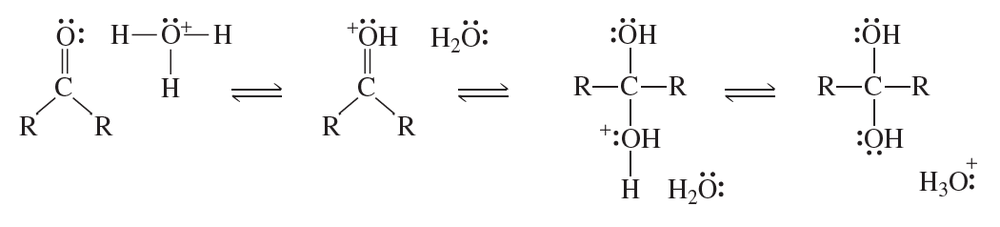
Step 1: Identify the reactants and the type of reaction. In this case, the reaction involves acetaldehyde (CH₃CHO) and hydronium ion (H₃O⁺), leading to the formation of a protonated intermediate.
Step 2: Use curved arrows to show the first step of the mechanism. The lone pair of electrons on the oxygen atom of acetaldehyde attacks the hydrogen atom of the hydronium ion (H₃O⁺), forming a bond and resulting in the protonation of the carbonyl oxygen.
Step 3: Represent the intermediate structure. After protonation, the oxygen of acetaldehyde becomes positively charged, forming CH₃CHOH⁺. This step increases the electrophilicity of the carbonyl carbon.
Step 4: Show the nucleophilic attack by water (H₂O). The lone pair of electrons on the oxygen atom of water attacks the electrophilic carbonyl carbon, forming a bond and leading to the formation of a tetrahedral intermediate.
Step 5: Depict the final equilibrium. The tetrahedral intermediate rearranges, and a proton transfer occurs, resulting in the formation of a geminal diol (CH₃C(OH)₂) and regeneration of the hydronium ion (H₃O⁺).
Verified video answer for a similar problem:
This video solution was recommended by our tutors as helpful for the problem above
Video duration:
6m
Play a video:
0 Comments
Key Concepts
Here are the essential concepts you must grasp in order to answer the question correctly.
Curved Arrows in Mechanisms
Curved arrows are used in organic chemistry to represent the movement of electrons during chemical reactions. They indicate the direction of electron flow, showing how bonds are formed or broken. Understanding how to draw and interpret these arrows is crucial for visualizing reaction mechanisms and predicting the outcome of reactions.
Acid-base reactions involve the transfer of protons (H⁺ ions) between reactants. In these reactions, an acid donates a proton while a base accepts it. Recognizing the roles of acids and bases in a reaction is essential for understanding the mechanism, as it helps identify the electron donors and acceptors involved.
Resonance structures are different ways of drawing the same molecule that illustrate the delocalization of electrons. They are important in understanding the stability and reactivity of intermediates in a reaction mechanism. Recognizing resonance can help predict the most stable form of a molecule and its behavior during a reaction.