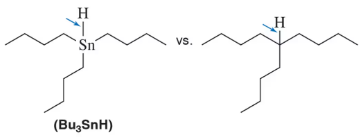
Tributyltin hydride (Bu3SnH) is often used as a 'radical carrier' in radical reactions. Which bond would you expect to be weaker, Sn–H or C–H? How might this relate to radical stability? Explain your answer.
Verified step by step guidance
1
Identify the bonds in question: Sn–H in tributyltin hydride (Bu₃SnH) and C–H in a typical alkane. The image shows the structures of these compounds, highlighting the Sn–H and C–H bonds.
Understand bond strength: Bond strength is related to the bond dissociation energy (BDE). Generally, bonds involving heavier atoms like tin (Sn) tend to be weaker than those involving lighter atoms like carbon (C). This is due to the larger atomic size and lower electronegativity of tin compared to carbon.
Consider radical stability: In radical reactions, the stability of the radical formed after bond cleavage is crucial. A weaker bond is more likely to break, forming a radical. The Sn–H bond is weaker, making it more prone to homolytic cleavage, thus forming a tin radical.
Relate bond strength to radical stability: The stability of the radical formed is influenced by the atom's ability to stabilize the unpaired electron. Tin radicals are relatively stable due to the ability of tin to delocalize the unpaired electron over its larger atomic orbitals.
Conclude the relationship: The weaker Sn–H bond in Bu₃SnH facilitates the formation of radicals, making it an effective radical carrier. This is because the tin radical formed is stable, allowing it to participate in further radical reactions efficiently.
Verified video answer for a similar problem:
This video solution was recommended by our tutors as helpful for the problem above
Play a video:
0 Comments
Key Concepts
Here are the essential concepts you must grasp in order to answer the question correctly.
Bond Strength
Bond strength refers to the energy required to break a bond between two atoms. In the context of Sn–H versus C–H bonds, Sn–H bonds are generally weaker due to the larger atomic size and lower electronegativity of tin compared to carbon, making it easier to break and form radicals.
Radical stability is influenced by the ability of a radical to delocalize its unpaired electron. Radicals formed from weaker bonds, like Sn–H, are often more stable because the unpaired electron can be better accommodated by the larger atomic orbitals of tin, reducing the energy of the radical species.
Radical reactions involve species with unpaired electrons and are initiated by breaking weak bonds. Tributyltin hydride (Bu₃SnH) acts as a radical carrier, facilitating the generation of radicals due to its weak Sn–H bond, which is crucial for initiating and propagating radical chain reactions.

 Verified step by step guidance
 06:00
06:00