In the following reaction, which C―H bond would be most likely to react with a bromine radical?
Verified step by step guidance
1
Identify the type of reaction: This problem involves a radical halogenation reaction, specifically with bromine radicals. Bromine radicals are selective and prefer to react with the most stable radical intermediates.
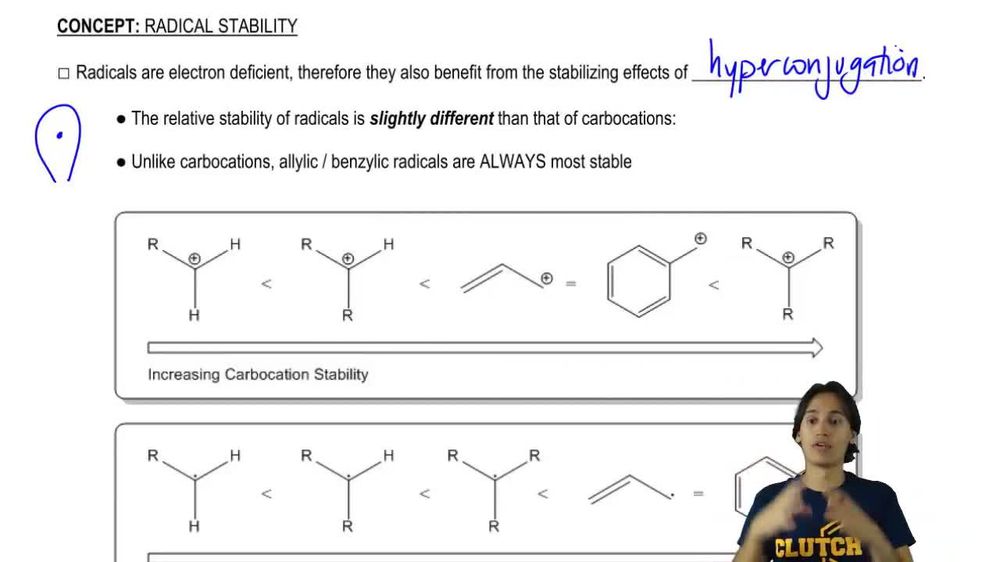
Consider the stability of radical intermediates: In radical halogenation, the stability of the radical formed after hydrogen abstraction is crucial. Tertiary radicals are more stable than secondary radicals, which are more stable than primary radicals.
Analyze the structure of the molecule: Examine the molecule to identify the different types of C―H bonds present. Determine which carbon atoms are primary, secondary, or tertiary.
Evaluate the bond dissociation energies: Generally, the C―H bond at a tertiary carbon will have a lower bond dissociation energy compared to secondary or primary C―H bonds, making it more likely to react with a bromine radical.
Select the most likely C―H bond: Based on the stability of the radical intermediates and the bond dissociation energies, choose the C―H bond at the tertiary carbon as the most likely to react with a bromine radical.
Verified video answer for a similar problem:
This video solution was recommended by our tutors as helpful for the problem above
Play a video:
0 Comments
Key Concepts
Here are the essential concepts you must grasp in order to answer the question correctly.
Radical Halogenation
Radical halogenation is a reaction where a halogen, such as bromine, reacts with hydrocarbons to form haloalkanes. The process involves the formation of radicals, which are highly reactive species with unpaired electrons. Understanding the mechanism of radical formation and propagation is crucial for predicting which bonds are likely to react.
In radical halogenation, the reactivity of C-H bonds is influenced by their bond strength. Weaker C-H bonds, typically found in tertiary carbons, are more susceptible to radical attack due to lower energy required for bond cleavage. Identifying the weakest C-H bond in a molecule helps predict the site of radical attack.
The stability of the resulting radical is a key factor in determining which C-H bond will react. More stable radicals, such as tertiary radicals, are favored due to their ability to better distribute the unpaired electron. This stability is often achieved through hyperconjugation and resonance, making certain C-H bonds more reactive.


 Verified step by step guidance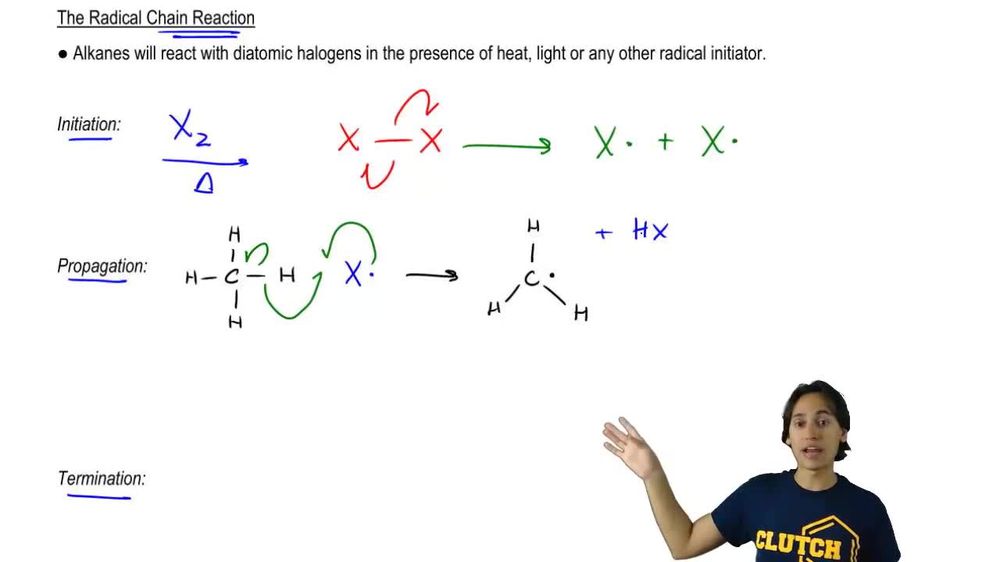
 12:11
12:11