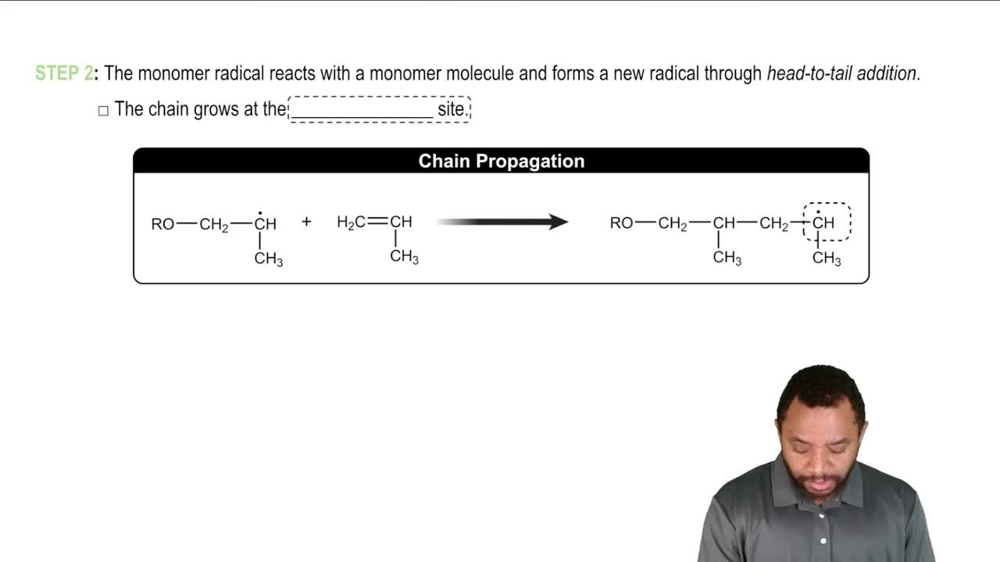
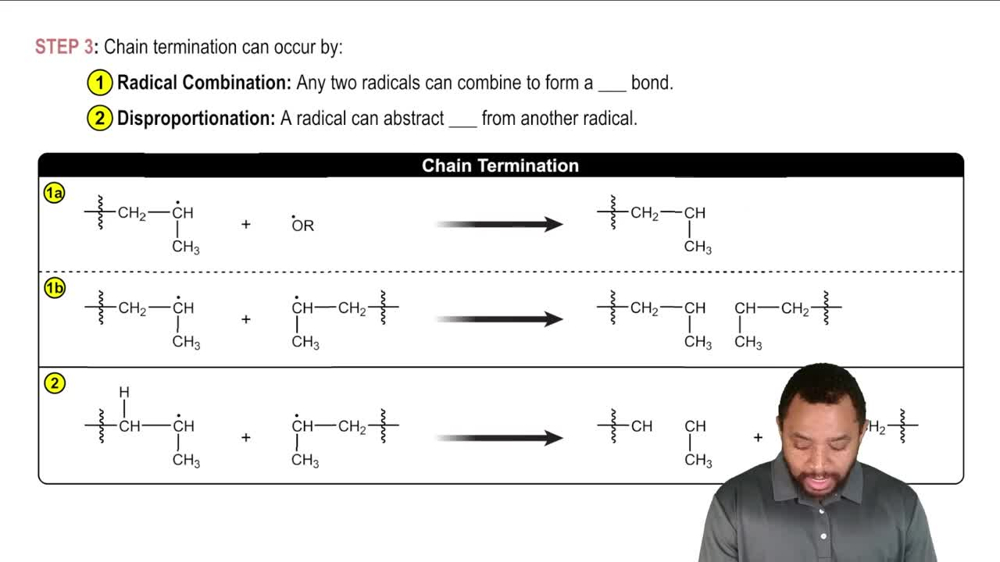
Haloalkanes can be reduced to alkanes using radical reactions involving Bu₃SnH and a catalytic amount of AIBN. Suggest a mechanism for this reaction. [Pay close attention to the bonds formed and broken in developing your mechanism.]
Verified step by step guidance
1
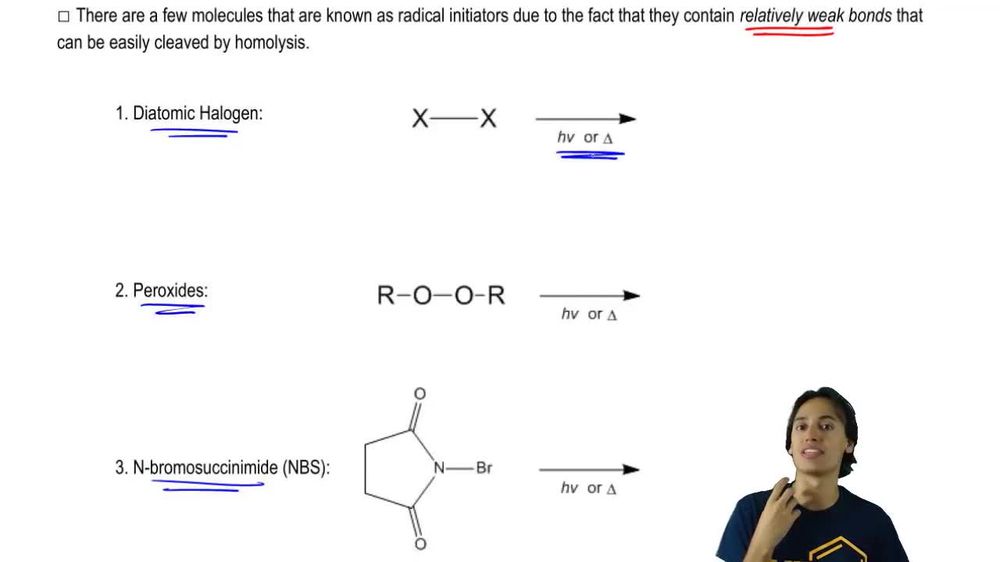
Begin by understanding the role of AIBN (azobisisobutyronitrile) in the reaction. AIBN is a radical initiator that decomposes upon heating to form two 2-cyanoprop-2-yl radicals. This step is crucial as it initiates the radical chain reaction.
The 2-cyanoprop-2-yl radical generated from AIBN abstracts a hydrogen atom from Bu₃SnH, forming a Bu₃Sn radical. This step is important as it generates the tin radical necessary for the propagation of the radical chain reaction.
The Bu₃Sn radical then abstracts the bromine atom from the haloalkane, forming an alkyl radical and Bu₃SnBr. This step involves the breaking of the C-Br bond and the formation of a new C-Sn bond.
The alkyl radical formed in the previous step abstracts a hydrogen atom from another molecule of Bu₃SnH, forming the alkane product and regenerating the Bu₃Sn radical. This step completes the radical chain reaction and ensures the continuation of the process.
Finally, the regenerated Bu₃Sn radical can continue to react with more haloalkane molecules, propagating the radical chain reaction. This step highlights the catalytic nature of the reaction, as the Bu₃Sn radical is continuously regenerated.
Verified video answer for a similar problem:
This video solution was recommended by our tutors as helpful for the problem above
Video duration:
8m
Play a video:
0 Comments
Key Concepts
Here are the essential concepts you must grasp in order to answer the question correctly.
Radical Initiation
Radical initiation is the first step in radical reactions where radicals are generated. In this mechanism, AIBN (azobisisobutyronitrile) acts as a radical initiator, decomposing upon heating to form nitrogen gas and two 2-cyanoprop-2-yl radicals. These radicals are crucial for starting the chain reaction by abstracting hydrogen from Bu₃SnH, generating a tin radical.
Radical propagation involves the reaction of radicals with stable molecules to form new radicals, continuing the chain reaction. The tin radical generated in the initiation step abstracts the halogen atom from the haloalkane, forming an alkyl radical and Bu₃SnBr. The alkyl radical then reacts with Bu₃SnH, regenerating the tin radical and forming the alkane product.
Radical termination occurs when two radicals combine to form a stable molecule, effectively ending the chain reaction. In this mechanism, termination can happen when two alkyl radicals or two tin radicals combine, although the primary focus is on the propagation steps that lead to the desired alkane product. Termination ensures that the reaction does not continue indefinitely, stabilizing the system.