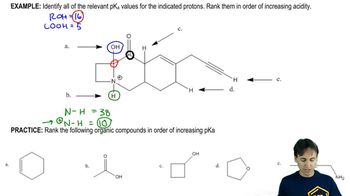
Predict the relative pKa values of cyclopropene and cyclopropane.
Verified step by step guidance
1
Step 1: Understand the concept of pKa. The pKa value is a measure of the acidity of a compound. Lower pKa values indicate stronger acids, while higher pKa values indicate weaker acids.
Step 2: Analyze the structures of cyclopropene and cyclopropane. Cyclopropene contains a double bond, making it an unsaturated compound, while cyclopropane is a saturated compound with only single bonds.
Step 3: Consider the effect of hybridization on acidity. In cyclopropene, the sp2-hybridized carbon atoms in the double bond are more electronegative than the sp3-hybridized carbon atoms in cyclopropane. This increases the acidity of cyclopropene compared to cyclopropane.
Step 4: Evaluate the ring strain in both molecules. Both cyclopropene and cyclopropane have significant ring strain due to their three-membered ring structure. However, the presence of the double bond in cyclopropene further increases the strain, which can make the molecule more acidic.
Step 5: Predict the relative pKa values. Based on the hybridization and ring strain, cyclopropene is expected to have a lower pKa (stronger acid) compared to cyclopropane, which has a higher pKa (weaker acid).
Verified video answer for a similar problem:
This video solution was recommended by our tutors as helpful for the problem above
Video duration:
9m
Play a video:
0 Comments
Key Concepts
Here are the essential concepts you must grasp in order to answer the question correctly.
pKa and Acidity
pKa is a quantitative measure of the acidity of a compound, indicating the strength of an acid in solution. A lower pKa value corresponds to a stronger acid, meaning it dissociates more readily to release protons (H+). Understanding pKa is essential for predicting the relative acidity of different compounds, such as cyclopropene and cyclopropane.
Cyclopropene (structure A) contains a double bond, which introduces strain and makes it more reactive compared to cyclopropane (structure B), which has only single bonds. The presence of the double bond in cyclopropene contributes to its higher acidity, as the resulting anion from deprotonation is stabilized by resonance, unlike the anion from cyclopropane.
Resonance stabilization occurs when a molecule can be represented by multiple valid Lewis structures, allowing for the delocalization of electrons. In the case of cyclopropene, the anion formed after deprotonation can be stabilized by resonance, making it more favorable for the compound to lose a proton compared to cyclopropane, which lacks such stabilization.