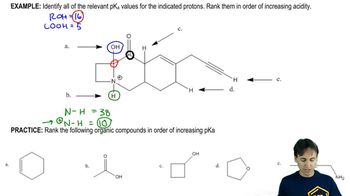
Predict the relative pKa values of cyclopentadiene and cycloheptatriene.
Verified step by step guidance
1
Step 1: Understand the concept of pKa. The pKa value is a measure of the acidity of a compound. Lower pKa values indicate stronger acids, while higher pKa values indicate weaker acids. Acidity is influenced by the stability of the conjugate base formed after deprotonation.
Step 2: Analyze the structure of cyclopentadiene (A). Cyclopentadiene has a conjugated system with alternating double bonds, and upon deprotonation, it forms a cyclopentadienyl anion. This anion is aromatic because it follows Huckel's rule (4n+2 π electrons, where n=1). Aromaticity stabilizes the conjugate base, making cyclopentadiene relatively acidic.
Step 3: Analyze the structure of cycloheptatriene (B). Cycloheptatriene has a conjugated system, but upon deprotonation, it forms a cycloheptatrienyl anion. This anion is not aromatic because it does not satisfy Huckel's rule (it has 8 π electrons, which is not 4n+2). The lack of aromatic stabilization makes the conjugate base less stable, resulting in cycloheptatriene being less acidic compared to cyclopentadiene.
Step 4: Compare the relative pKa values. Cyclopentadiene has a lower pKa value due to the aromatic stabilization of its conjugate base, while cycloheptatriene has a higher pKa value because its conjugate base is not aromatic and less stable.
Step 5: Conclude that cyclopentadiene is the stronger acid (lower pKa) compared to cycloheptatriene (higher pKa), based on the stability of their respective conjugate bases.
Verified video answer for a similar problem:
This video solution was recommended by our tutors as helpful for the problem above
Video duration:
9m
Play a video:
0 Comments
Key Concepts
Here are the essential concepts you must grasp in order to answer the question correctly.
pKa and Acidity
pKa is a measure of the acidity of a compound, indicating the strength of an acid in solution. A lower pKa value corresponds to a stronger acid, meaning it dissociates more readily to release protons (H+). Understanding pKa is crucial for predicting the relative acidity of different compounds, such as cyclopentadiene and cycloheptatriene.
The stability of a conjugate base significantly influences the acidity of its parent acid. A more stable conjugate base will result in a stronger acid. In the case of cyclopentadiene and cycloheptatriene, analyzing the resonance structures and electron delocalization in their conjugate bases helps predict which compound will have a lower pKa.
Cyclopentadiene and cycloheptatriene differ in ring size, which affects their hybridization and stability. Cyclopentadiene, with a five-membered ring, experiences more ring strain compared to cycloheptatriene, which has a seven-membered ring. This strain can influence the acidity, as more strain can lead to a less stable structure and thus a higher pKa.