Which is a better nucleophile? c. CH3O− or CH3OH in H2O
Verified step by step guidance
1
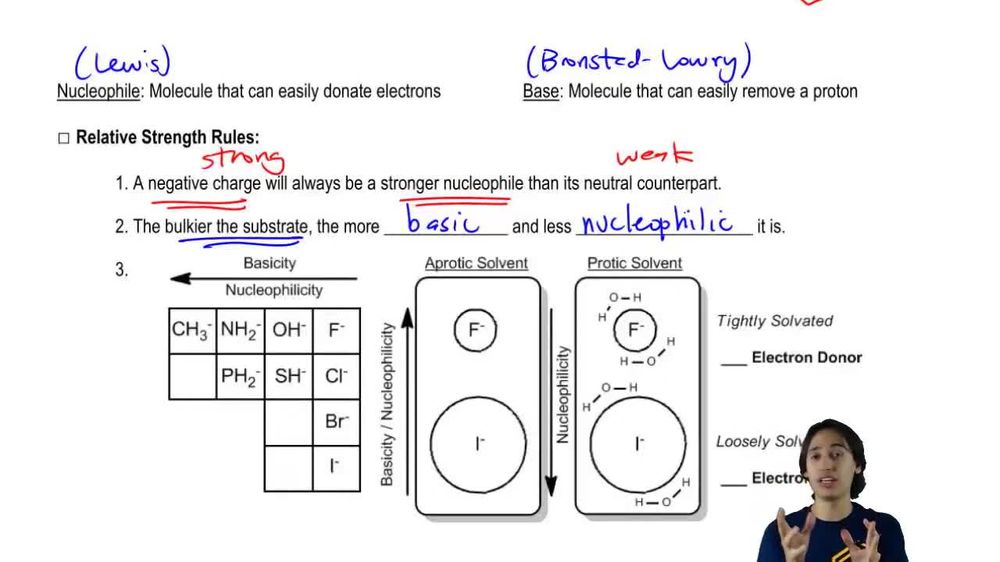
Step 1: Understand the concept of nucleophilicity. Nucleophilicity refers to the ability of a species to donate a pair of electrons to an electrophile. It is influenced by factors such as charge, electronegativity, solvent effects, and steric hindrance.
Step 2: Compare the two species given in the problem: CH3O− (methoxide ion) and CH3OH (methanol). CH3O− is negatively charged, while CH3OH is neutral. A negatively charged species is generally a stronger nucleophile than its neutral counterpart because it has a higher electron density to donate.
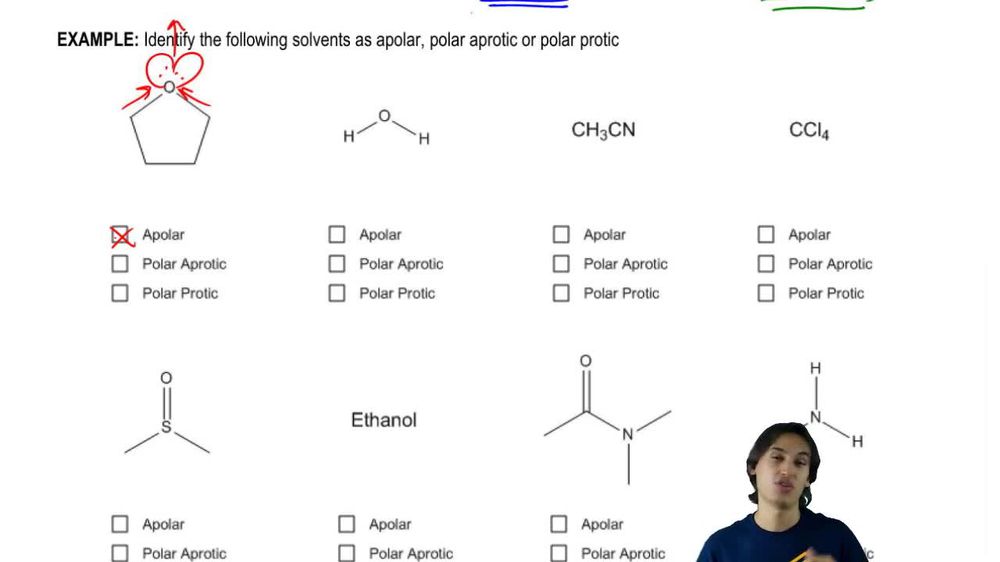
Step 3: Consider the solvent, CH3OH (methanol), which is a polar protic solvent. Polar protic solvents can hydrogen bond with nucleophiles, stabilizing them and reducing their nucleophilicity. However, CH3O−, being negatively charged, will still be a better nucleophile than CH3OH, even in this solvent.
Step 4: Analyze the role of electronegativity. Both CH3O− and CH3OH have oxygen as the atom donating the electron pair. Since the electronegativity of oxygen is the same in both species, this factor does not affect the comparison.
Step 5: Conclude that CH3O− is the better nucleophile compared to CH3OH in CH3OH solvent, primarily due to its negative charge, which increases its electron-donating ability, despite the stabilizing effect of the polar protic solvent.
Verified video answer for a similar problem:
This video solution was recommended by our tutors as helpful for the problem above
Video duration:
1m
Play a video:
0 Comments
Key Concepts
Here are the essential concepts you must grasp in order to answer the question correctly.
Nucleophilicity
Nucleophilicity refers to the ability of a species to donate an electron pair to an electrophile, forming a chemical bond. Stronger nucleophiles are typically negatively charged or have lone pairs that can be readily donated. Factors influencing nucleophilicity include charge, electronegativity, and solvent effects, with more basic species generally being better nucleophiles.
While basicity measures a species' ability to accept protons (H+), nucleophilicity focuses on its ability to donate electron pairs. Although there is a correlation between the two, they are not identical; for example, a strong base may not always be a strong nucleophile in a given solvent. Understanding this distinction is crucial for predicting reactivity in organic reactions.
Understanding the difference between basicity and nucleophilicity.
Solvent Effects
The solvent can significantly influence nucleophilicity, particularly in polar protic solvents like CH3OH (methanol). In such solvents, nucleophiles with negative charges can be stabilized by solvation, which can hinder their reactivity. Therefore, comparing nucleophiles in different solvents is essential, as the solvent can alter the relative nucleophilicity of species like CH3O− and CH3OH.

 1:44 minutes
 Verified step by step guidance
 08:27
08:27