Rank the following species in each set from best nucleophile to poorest nucleophile. a.
Verified step by step guidance
1
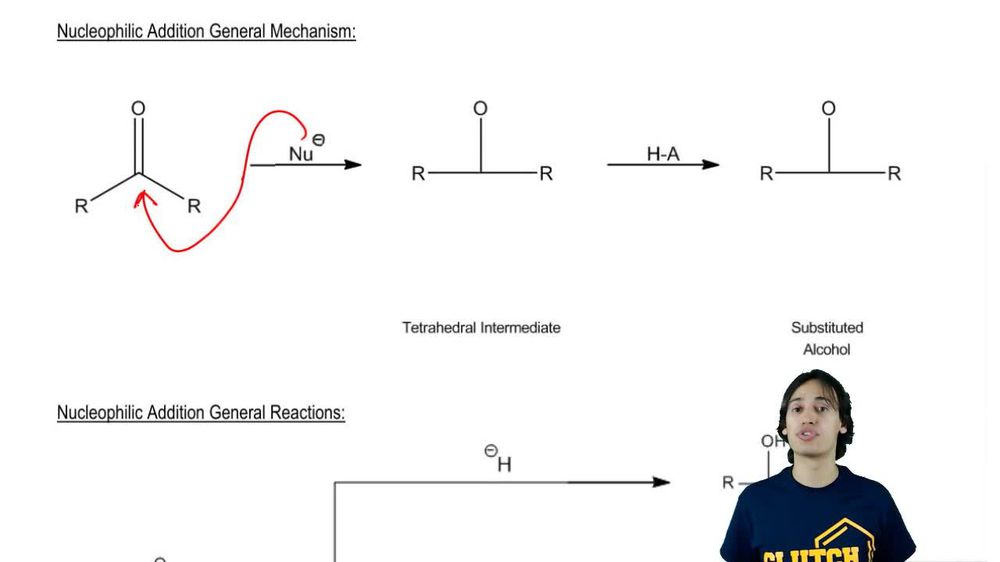
Step 1: Understand the concept of nucleophilicity. Nucleophilicity refers to the ability of a species to donate a pair of electrons to an electrophile. Factors affecting nucleophilicity include charge, electronegativity, steric hindrance, and solvent effects.
Step 2: Analyze the charge of each species. Generally, negatively charged species are better nucleophiles than their neutral counterparts because they have a higher electron density available for donation.
Step 3: Consider electronegativity. Species with lower electronegativity are better nucleophiles because they hold onto their electrons less tightly, making them more available for bonding.
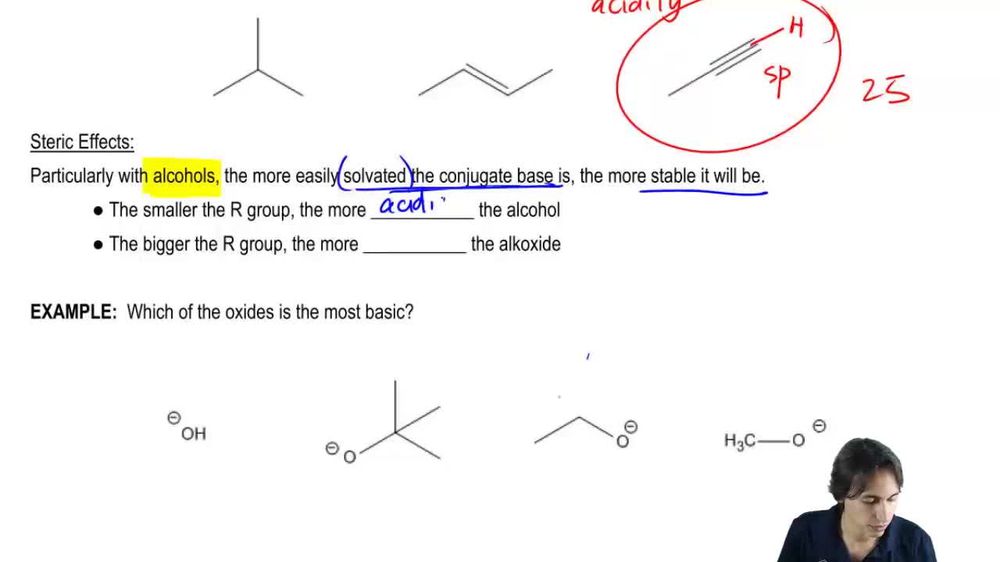
Step 4: Evaluate steric hindrance. Bulky groups around the nucleophilic center can hinder its ability to approach the electrophile, reducing nucleophilicity.
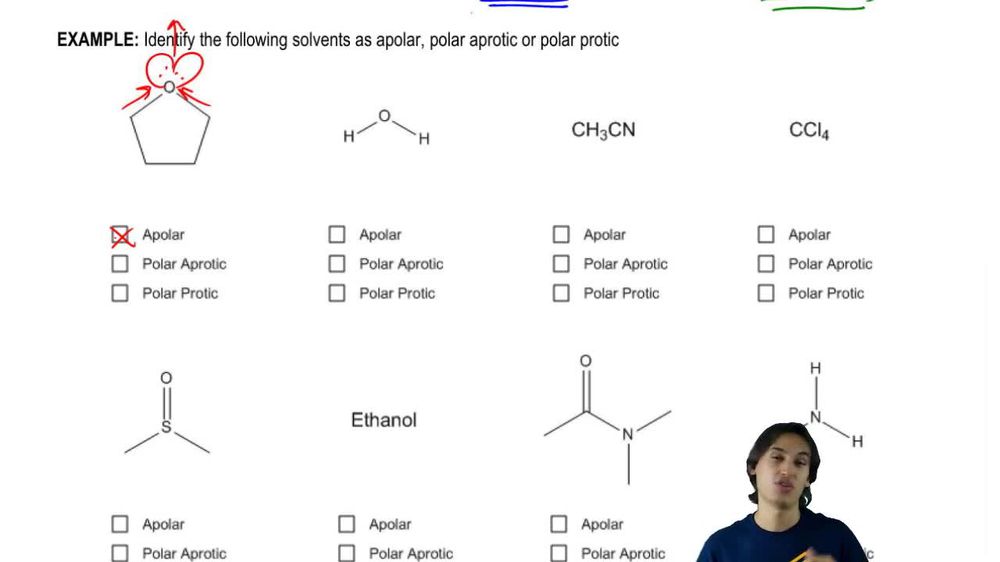
Step 5: Account for solvent effects. In polar protic solvents, nucleophilicity decreases for smaller ions due to hydrogen bonding, while in polar aprotic solvents, nucleophilicity is less affected by hydrogen bonding and depends more on charge and electronegativity.
Verified video answer for a similar problem:
This video solution was recommended by our tutors as helpful for the problem above
Video duration:
5m
Play a video:
0 Comments
Key Concepts
Here are the essential concepts you must grasp in order to answer the question correctly.
Nucleophilicity
Nucleophilicity refers to the ability of a species to donate an electron pair to an electrophile during a chemical reaction. It is influenced by factors such as charge, electronegativity, and steric hindrance. Generally, negatively charged species are better nucleophiles than neutral ones, and less electronegative atoms are more nucleophilic due to their willingness to share electrons.
The solvent can significantly impact nucleophilicity. In polar protic solvents, nucleophiles are often stabilized by solvation, which can hinder their reactivity. Conversely, in polar aprotic solvents, nucleophiles are less solvated and can exhibit greater reactivity, making the choice of solvent crucial when ranking nucleophiles.
Steric hindrance refers to the crowding around a reactive site that can impede the approach of a nucleophile to an electrophile. Bulky groups attached to a nucleophile can reduce its ability to effectively collide with and react with an electrophile, thus affecting its nucleophilicity. Smaller, less hindered nucleophiles are generally more effective in nucleophilic attacks.