Which is a better nucleophile? d. CH3O− or CH3OH in DMSO
Verified step by step guidance
1
Identify the key difference between CH3O− (methoxide ion) and CH3OH (methanol). CH3O− is the conjugate base of CH3OH, meaning CH3O− is negatively charged, while CH3OH is neutral.
Understand the role of charge in nucleophilicity. A negatively charged species (CH3O−) is generally a stronger nucleophile than its neutral counterpart (CH3OH) because the negative charge increases its electron density, making it more reactive toward electrophiles.
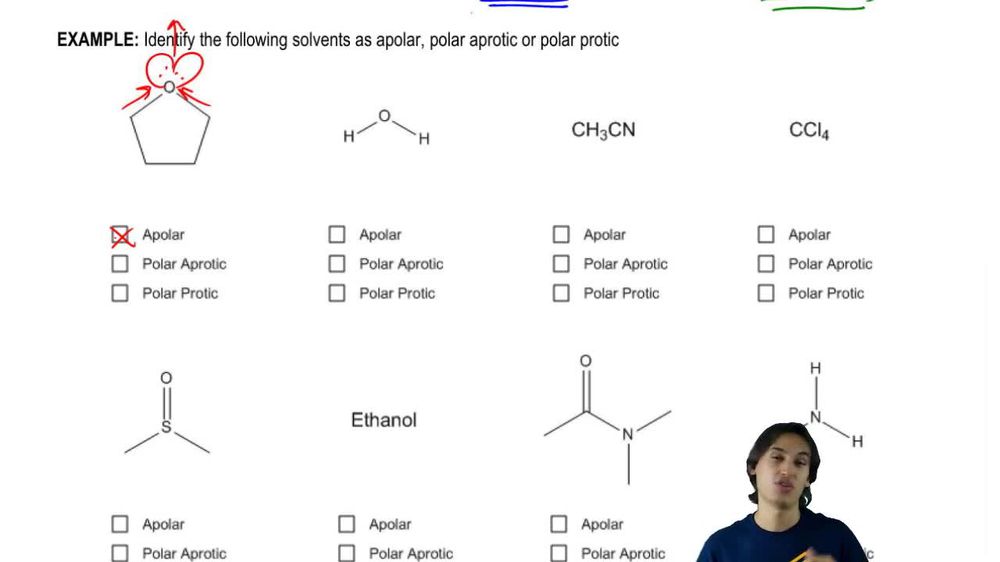
Consider the solvent, DMSO (dimethyl sulfoxide). DMSO is a polar aprotic solvent, which does not hydrogen bond with nucleophiles. This allows negatively charged nucleophiles like CH3O− to remain free and highly reactive, enhancing their nucleophilicity.
Compare the nucleophilicity of CH3O− and CH3OH in DMSO. CH3O−, being negatively charged and not hindered by hydrogen bonding in DMSO, will be a much better nucleophile than CH3OH, which is neutral and less reactive.
Conclude that CH3O− is the better nucleophile in DMSO due to its negative charge and the solvent's ability to stabilize the ion without reducing its reactivity.
Verified video answer for a similar problem:
This video solution was recommended by our tutors as helpful for the problem above
Video duration:
1m
Play a video:
0 Comments
Key Concepts
Here are the essential concepts you must grasp in order to answer the question correctly.
Nucleophilicity
Nucleophilicity refers to the ability of a species to donate an electron pair to an electrophile, forming a chemical bond. Stronger nucleophiles are typically negatively charged or have lone pairs that can be readily donated. Factors influencing nucleophilicity include charge, electronegativity, and solvent effects, with polar aprotic solvents like DMSO enhancing nucleophilic strength.
The choice of solvent can significantly impact nucleophilicity. In polar aprotic solvents such as DMSO, nucleophiles are less solvated, allowing them to remain more reactive. This contrasts with polar protic solvents, where nucleophiles can be stabilized by hydrogen bonding, reducing their reactivity. Understanding solvent effects is crucial for predicting reaction outcomes.
When comparing nucleophiles like CH3O− (methoxide ion) and CH3OH (methanol), the presence of a negative charge on CH3O− makes it a stronger nucleophile than the neutral CH3OH. The methoxide ion is more reactive due to its higher electron density and ability to donate electrons more readily, especially in a suitable solvent like DMSO.

 1:53 minutes
 Verified step by step guidance
 08:27
08:27