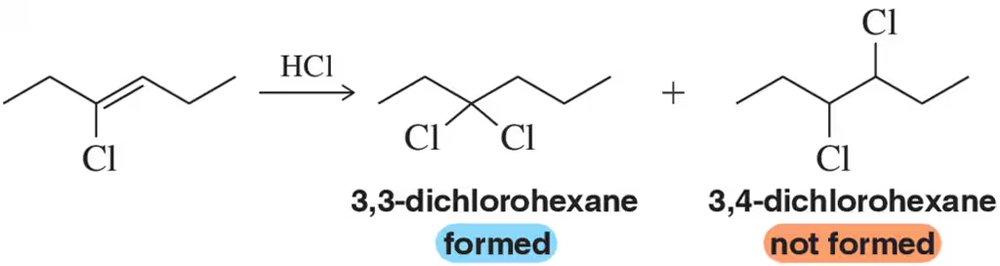
The reaction of (E)-3-chlorohex-3-ene with HCl results in the selective formation of 3,3-dichlorohexane instead of 3,4-dichlorohexane. Explain this result.
Verified step by step guidance
1
Identify the structure of (E)-3-chlorohex-3-ene. The 'E' configuration indicates that the highest priority groups on either side of the double bond are on opposite sides. The molecule has a double bond between the third and fourth carbon atoms, with a chlorine atom attached to the third carbon.
Understand the mechanism of the addition of HCl to alkenes. The reaction proceeds via electrophilic addition, where the π electrons of the double bond attack the hydrogen atom of HCl, forming a carbocation intermediate.
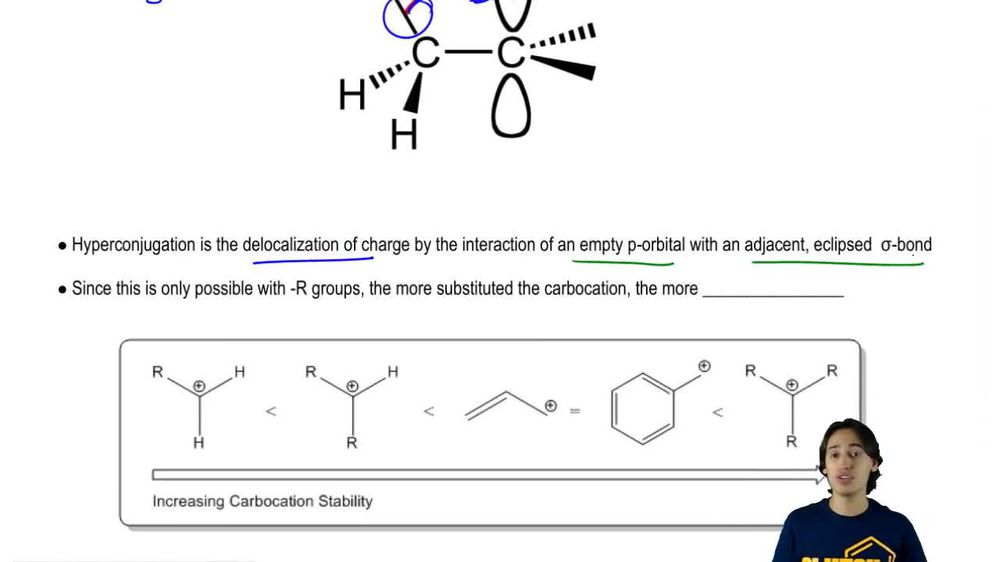
Determine the stability of possible carbocation intermediates. The initial attack of the π electrons on HCl will form a carbocation at the more substituted carbon, which is the third carbon in this case, due to the stability provided by hyperconjugation and inductive effects.
Consider the formation of the 3,3-dichlorohexane product. The carbocation formed at the third carbon is more stable and will preferentially react with the chloride ion to form the 3,3-dichlorohexane product, as the chloride ion will attack the carbocation directly.
Explain why 3,4-dichlorohexane is not formed. The formation of a carbocation at the fourth carbon is less favorable due to its lower stability compared to the carbocation at the third carbon. Therefore, the reaction selectively forms 3,3-dichlorohexane.
Verified video answer for a similar problem:
This video solution was recommended by our tutors as helpful for the problem above
Video duration:
4m
Play a video:
0 Comments
Key Concepts
Here are the essential concepts you must grasp in order to answer the question correctly.
Markovnikov's Rule
Markovnikov's Rule states that in the addition of HX to an alkene, the hydrogen atom bonds to the carbon with more hydrogen substituents, while the halide bonds to the carbon with fewer hydrogen substituents. This rule helps predict the major product in electrophilic addition reactions, explaining why the chlorine in HCl adds to the more substituted carbon in (E)-3-chlorohex-3-ene.
Carbocation stability is crucial in determining the pathway of electrophilic addition reactions. Tertiary carbocations are more stable than secondary or primary ones due to hyperconjugation and inductive effects. In the reaction, the formation of a more stable tertiary carbocation at the 3-position leads to the selective formation of 3,3-dichlorohexane.
Regioselectivity refers to the preference for the formation of one constitutional isomer over another in a chemical reaction. In the given reaction, regioselectivity is influenced by Markovnikov's Rule and carbocation stability, resulting in the selective formation of 3,3-dichlorohexane as the major product over 3,4-dichlorohexane.