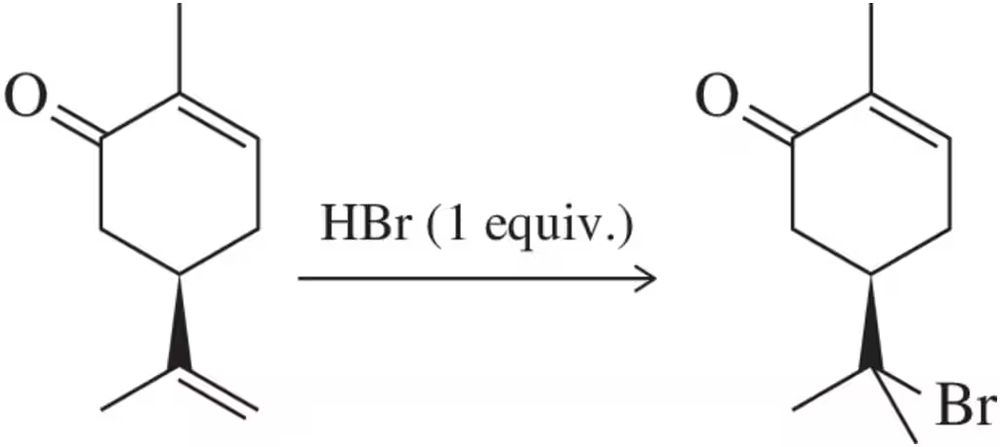
If you react carvone with a single equivalent of HBr, only one product is produced, even though carvone has two carbon–carbon double bonds. Explain this observation.
Verified step by step guidance
1
Carvone is a terpenoid with two carbon-carbon double bonds, one in the ring and one in the side chain. The reactivity of these double bonds can differ based on their location and the surrounding chemical environment.
When HBr is added to carvone, it acts as an electrophile due to the polarization of the H-Br bond, where H is partially positive and Br is partially negative.
The double bond in the ring is more substituted compared to the double bond in the side chain. According to Markovnikov's rule, the more substituted double bond is more likely to react with HBr because it can form a more stable carbocation intermediate.
The reaction proceeds with the addition of HBr across the more substituted double bond, leading to the formation of a carbocation at the more stable position. This carbocation is then attacked by the bromide ion (Br⁻) to form the final product.
The less substituted double bond does not react under these conditions because the formation of a carbocation at this position would be less stable. Therefore, only one product is formed from the reaction of carvone with a single equivalent of HBr.
Verified video answer for a similar problem:
This video solution was recommended by our tutors as helpful for the problem above
Video duration:
2m
Play a video:
0 Comments
Key Concepts
Here are the essential concepts you must grasp in order to answer the question correctly.
Regioselectivity
Regioselectivity refers to the preference of a chemical reaction to occur at one direction or position over others in a molecule. In the case of carvone reacting with HBr, the reaction is regioselective, favoring one double bond over the other due to factors like steric hindrance or electronic effects, leading to a single product.
Markovnikov's Rule predicts the outcome of the addition of HX (where X is a halogen) to alkenes, stating that the hydrogen atom will attach to the carbon with more hydrogen substituents, while the halogen will attach to the carbon with fewer hydrogen substituents. This rule helps explain why only one product is formed when HBr is added to carvone.
Steric hindrance occurs when the size of groups within a molecule prevents chemical reactions at certain sites. In carvone, one of the double bonds may be less accessible due to bulky groups nearby, making it less reactive to HBr. This steric effect can lead to the selective reaction at the more accessible double bond, resulting in a single product.