What is the expected product for the reaction of each of the following alkenes with (i) HBr and (ii) HCl? (d)
Verified step by step guidance
1
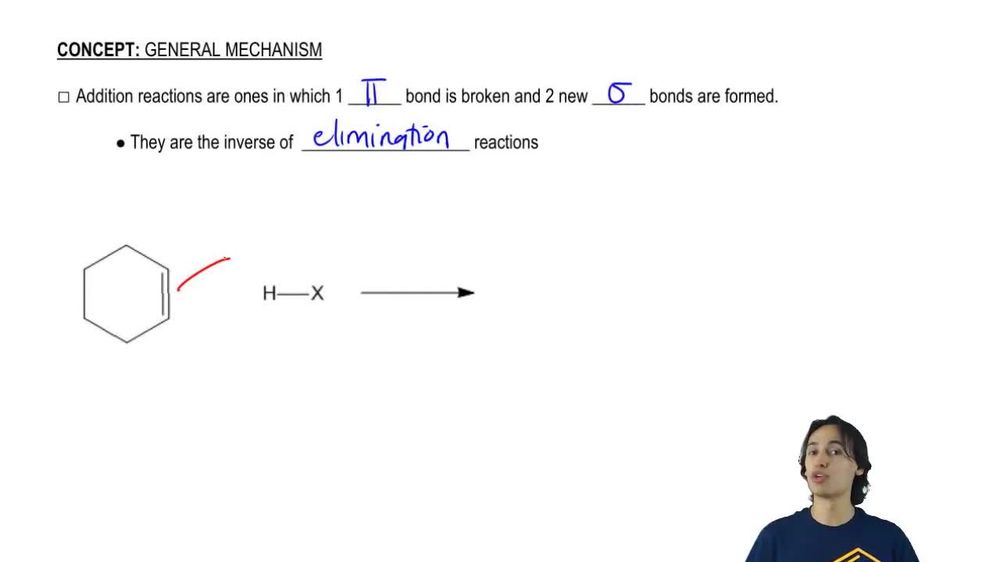
Identify the structure of the alkene in part (d). Alkenes are hydrocarbons with a carbon-carbon double bond, which is the site of reactivity in addition reactions.
Understand the mechanism of electrophilic addition of HX (where X is a halogen, such as Br or Cl) to alkenes. The reaction proceeds via the formation of a carbocation intermediate.
For the reaction with HBr, the alkene will react with HBr to form a carbocation. The hydrogen from HBr will add to the less substituted carbon of the double bond, following Markovnikov's rule, which states that the more stable carbocation is formed.
Once the carbocation is formed, the bromide ion (Br-) will attack the positively charged carbon, resulting in the formation of the alkyl bromide product.
Repeat the process for the reaction with HCl. The mechanism is similar, where the chloride ion (Cl-) will attack the carbocation formed after the addition of HCl, resulting in the formation of the alkyl chloride product.
Verified video answer for a similar problem:
This video solution was recommended by our tutors as helpful for the problem above
Video duration:
2m
Play a video:
0 Comments
Key Concepts
Here are the essential concepts you must grasp in order to answer the question correctly.
Markovnikov's Rule
Markovnikov's Rule states that in the addition of HX (where X is a halogen) to an alkene, the hydrogen atom will attach to the carbon with the greater number of hydrogen atoms, while the halogen will attach to the carbon with fewer hydrogen atoms. This rule helps predict the major product in electrophilic addition reactions.
Electrophilic addition is a reaction where an electrophile reacts with an alkene, resulting in the addition of atoms across the double bond. The alkene's π electrons attack the electrophile, forming a carbocation intermediate, which is then attacked by a nucleophile, leading to the final product.
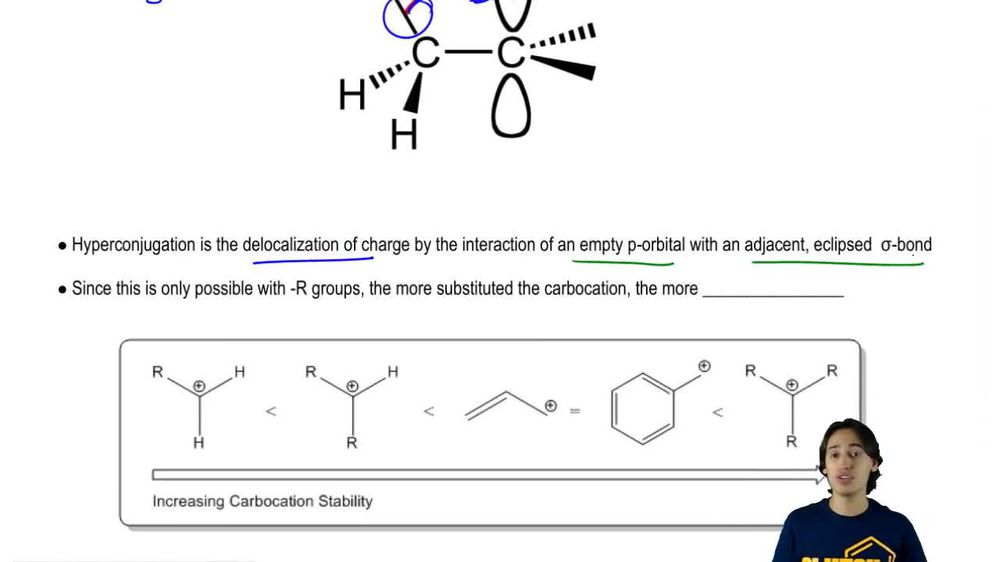
Carbocation stability is crucial in determining the major product of an electrophilic addition reaction. Tertiary carbocations are more stable than secondary, which are more stable than primary. The stability is influenced by hyperconjugation and the inductive effect, guiding the formation of the most stable intermediate during the reaction.