Ch. 9 - Substitution and Elimination Reactions of Alkyl Halides
Bruice - Organic Chemistry 8th Edition
Bruice8th EditionOrganic ChemistryISBN: 9780135213711Not the one you use?Change textbook
Chapter 10, Problem 65e

Draw the products of the following intramolecular reactions:
e.

Verified step by step guidance
1
Identify the functional groups present in the starting material. Look for groups that can participate in intramolecular reactions, such as nucleophiles and electrophiles.
Determine the type of intramolecular reaction that can occur. Common types include cyclization reactions, where a nucleophile attacks an electrophile within the same molecule to form a ring.
Consider the size of the ring that will be formed. Intramolecular reactions often favor the formation of 5- or 6-membered rings due to their stability.
Draw the mechanism of the reaction, showing the movement of electrons. Use curved arrows to indicate the nucleophilic attack and the formation of the new bond.
Draw the final product, ensuring that all atoms are accounted for and that the stereochemistry is correct if applicable. Check for any possible rearrangements or additional reactions that might occur.

Verified video answer for a similar problem:

This video solution was recommended by our tutors as helpful for the problem above.
Video duration:
4m
Was this helpful?

Key Concepts

Here are the essential concepts you must grasp in order to answer the question correctly.

Intramolecular Reactions

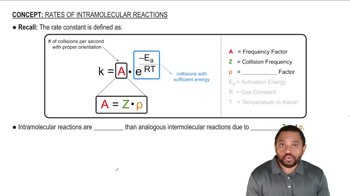
Intramolecular reactions occur within a single molecule, where functional groups react with each other to form new bonds. This type of reaction often leads to the formation of cyclic structures or new functional groups, and is crucial in organic synthesis. Understanding the spatial arrangement of atoms and the reactivity of different functional groups is essential for predicting the products of these reactions.
Recommended video:
2:29
Rates of Intramolecular Reactions Concept 1

Reaction Mechanisms

A reaction mechanism describes the step-by-step process by which reactants transform into products. It includes details about bond breaking and forming, intermediates, and transition states. Familiarity with common mechanisms, such as nucleophilic substitution or elimination, helps in predicting the outcome of intramolecular reactions and understanding the stability of the resulting products.
Recommended video:
Guided course
02:16
Heck Reaction Mechanism

Stereochemistry

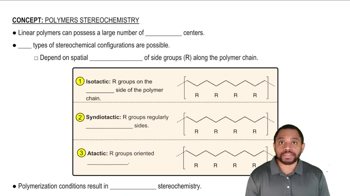
Stereochemistry involves the study of the spatial arrangement of atoms in molecules and how this affects their chemical behavior. In intramolecular reactions, the orientation of functional groups can lead to different stereoisomers, which may have distinct properties. Recognizing stereochemical outcomes is vital for accurately drawing products and understanding their reactivity and interactions.
Recommended video:
1:38
Polymer Stereochemistry Concept 1