Ch. 9 - Substitution and Elimination Reactions of Alkyl Halides
Bruice - Organic Chemistry 8th Edition
Bruice8th EditionOrganic ChemistryISBN: 9780135213711Not the one you use?Change textbook
Chapter 10, Problem 66b

For each of the following target molecules, design a multistep synthesis to show how it can be prepared from the given starting material:
b.

Verified step by step guidance
1
Step 1: Analyze the starting material and target molecule. The starting material is bromocyclohexane, and the target molecule is trans-1,2-dibromocyclohexane. This indicates that a bromine atom needs to be added to the cyclohexane ring in a trans configuration relative to the existing bromine atom.
Step 2: Perform a free radical bromination reaction. Use Br₂ and light (hv) to generate bromine radicals. This will add a bromine atom to the cyclohexane ring at a position adjacent to the existing bromine atom, forming a mixture of stereoisomers.
Step 3: Ensure the stereochemistry of the product. The reaction conditions should favor the formation of the trans isomer due to steric hindrance and the stability of the trans configuration. The trans-1,2-dibromocyclohexane is the desired product.
Step 4: Purify the product. Use techniques such as recrystallization or chromatography to isolate the trans isomer from any cis isomer or other byproducts formed during the reaction.
Step 5: Confirm the structure of the product. Use spectroscopic methods such as NMR or IR to verify the stereochemistry and ensure the product is trans-1,2-dibromocyclohexane.

Verified video answer for a similar problem:

This video solution was recommended by our tutors as helpful for the problem above.
Video duration:
4m
Was this helpful?

Key Concepts

Here are the essential concepts you must grasp in order to answer the question correctly.

Multistep Synthesis

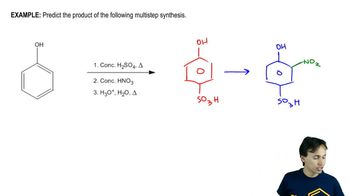
Multistep synthesis involves a series of chemical reactions that transform a starting material into a target molecule through intermediate compounds. Each step typically involves specific reagents and conditions that facilitate the desired transformations, such as functional group modifications or bond formations. Understanding the sequence of reactions and how to optimize each step is crucial for efficient synthesis.
Recommended video:
Guided course
02:15
Multistep Synthesis

Reaction Mechanisms

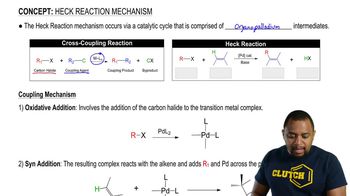
A reaction mechanism describes the step-by-step process by which reactants are converted into products, detailing the breaking and forming of bonds. Familiarity with mechanisms, such as nucleophilic substitutions or electrophilic additions, helps predict the outcomes of reactions and the stability of intermediates. This knowledge is essential for designing a synthesis pathway that is both feasible and efficient.
Recommended video:
Guided course
02:16
Heck Reaction Mechanism

Functional Group Transformations

Functional group transformations refer to the chemical reactions that convert one functional group into another, which is often necessary in organic synthesis. Recognizing how different functional groups can be interconverted allows chemists to strategically plan synthetic routes. Mastery of these transformations is vital for achieving the desired structure of the target molecule from the starting material.
Recommended video:
Guided course
02:36
Identifying Functional Groups