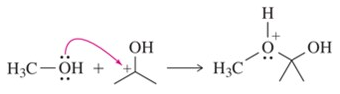
Identify the nucleophile and the electrophile in each of the following reactions. (a)
Verified step by step guidance
1
Step 1: Analyze the reaction provided in the image. The reaction involves methanol (CH₃OH) and a tertiary alcohol with a positively charged oxygen atom (OH⁺). The arrow indicates the movement of electrons from the lone pair on the oxygen atom of methanol to the positively charged oxygen atom of the tertiary alcohol.
Step 2: Define the nucleophile. A nucleophile is a species that donates a pair of electrons to form a bond. In this reaction, methanol (CH₃OH) acts as the nucleophile because its oxygen atom has lone pairs of electrons that can be donated.
Step 3: Define the electrophile. An electrophile is a species that accepts a pair of electrons to form a bond. In this reaction, the positively charged oxygen atom (OH⁺) of the tertiary alcohol acts as the electrophile because it is electron-deficient and can accept electrons.
Step 4: Explain the interaction. The lone pair of electrons on the oxygen atom of methanol is attracted to the positively charged oxygen atom of the tertiary alcohol. This results in the formation of a new bond between the oxygen atoms.
Step 5: Summarize the roles. Methanol (CH₃OH) is the nucleophile, donating electrons, and the positively charged oxygen atom (OH⁺) of the tertiary alcohol is the electrophile, accepting electrons.
Verified video answer for a similar problem:
This video solution was recommended by our tutors as helpful for the problem above
Play a video:
0 Comments
Key Concepts
Here are the essential concepts you must grasp in order to answer the question correctly.
Nucleophile
A nucleophile is a species that donates an electron pair to form a chemical bond in a reaction. Nucleophiles are typically negatively charged or neutral molecules with lone pairs of electrons. In the provided reaction, the hydroxide ion (OH-) acts as a nucleophile, attacking the electrophile to form a new bond.
An electrophile is a chemical species that accepts an electron pair from a nucleophile during a reaction. Electrophiles are usually positively charged or electron-deficient species. In the given reaction, the carbon atom in the alcohol group (attached to the hydroxyl group) acts as the electrophile, as it is susceptible to attack by the nucleophile.
A reaction mechanism describes the step-by-step sequence of elementary reactions by which overall chemical change occurs. Understanding the mechanism helps in identifying the roles of nucleophiles and electrophiles in a reaction. In this case, the mechanism illustrates how the nucleophile attacks the electrophile, leading to the formation of a new product.