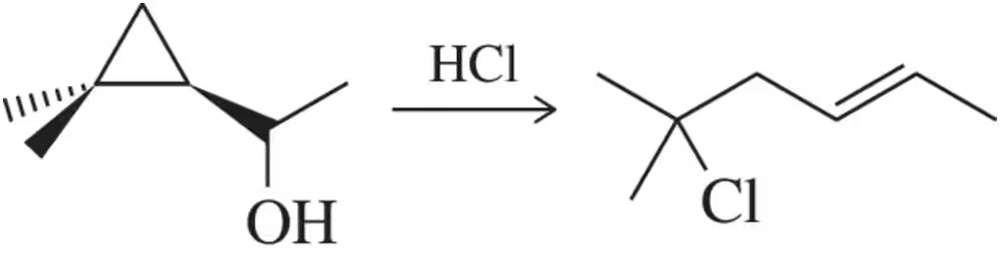
Suggest a mechanism for the following substitution reaction.
Verified step by step guidance
1
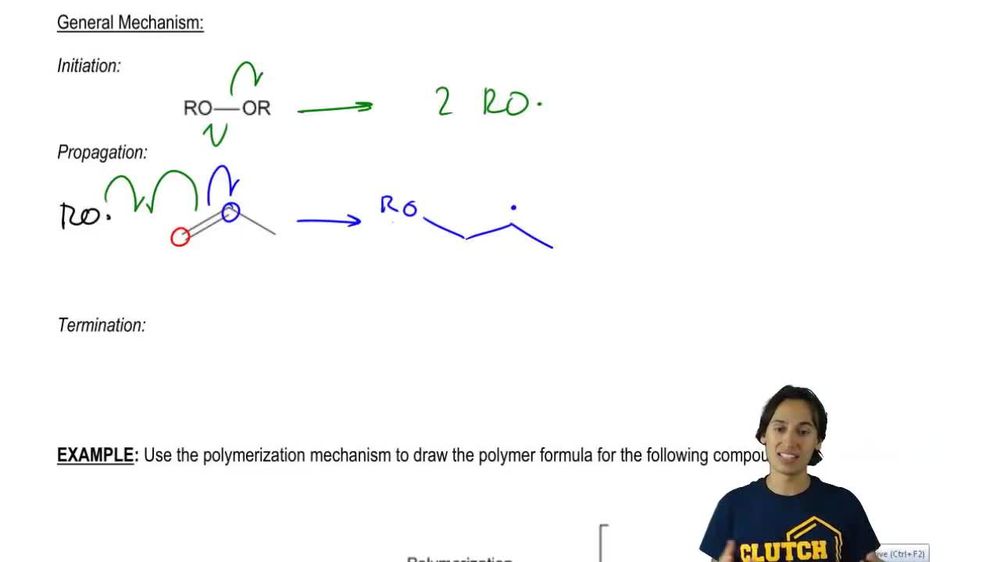
Analyze the reaction type: Determine whether the substitution reaction proceeds via a radical mechanism, nucleophilic substitution (SN1 or SN2), or another pathway. Based on the problem hint, this reaction likely involves radicals.
Identify the key components: Examine the reactants and products in the reaction image. Look for any halogens, alkyl groups, or other functional groups that may participate in radical formation or propagation.
Initiation step: Propose how radicals are generated in the reaction. This often involves homolytic cleavage of a bond, such as a halogen bond, under the influence of heat or light. Represent this step using MathML, e.g., .
Propagation steps: Suggest how the radicals interact with the substrate to form intermediates and eventually the product. For example, a radical might abstract a hydrogen atom or add to a double bond. Use MathML to represent these steps clearly.
Termination step: Describe how the radicals are quenched to complete the reaction. This could involve two radicals combining to form a stable molecule, e.g., .
Verified video answer for a similar problem:
This video solution was recommended by our tutors as helpful for the problem above
Play a video:
0 Comments
Key Concepts
Here are the essential concepts you must grasp in order to answer the question correctly.
Substitution Reactions
Substitution reactions involve the replacement of one atom or group in a molecule with another atom or group. In organic chemistry, these reactions can be classified into nucleophilic and electrophilic substitutions, depending on the nature of the attacking species. Understanding the mechanism of substitution reactions is crucial for predicting the products and the conditions under which the reaction occurs.
Radical mechanisms involve species with unpaired electrons, known as radicals, which can initiate reactions by abstracting atoms or groups from other molecules. These mechanisms typically proceed through three main steps: initiation, propagation, and termination. Familiarity with radical mechanisms is essential for analyzing reactions that involve radical intermediates, as they often lead to different products compared to ionic mechanisms.
A reaction mechanism is a step-by-step description of the process by which reactants are converted into products. It outlines the sequence of bond-breaking and bond-forming events, including the formation of intermediates. Understanding the reaction mechanism is vital for predicting the outcome of a reaction, including the stereochemistry and regioselectivity of the products.

 Verified step by step guidance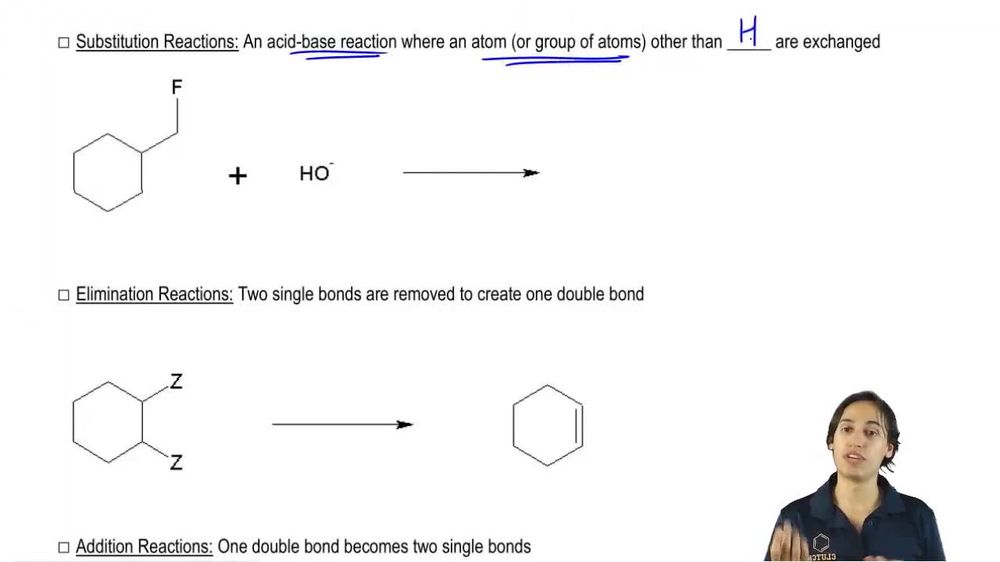
 01:34
01:34