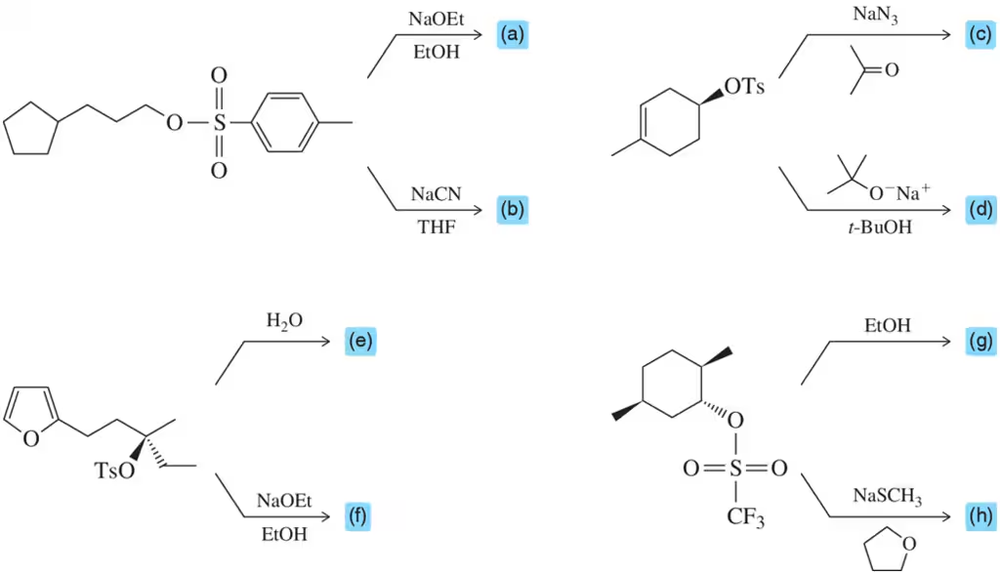
Predict the major product(s) of each of the following reactions.
Verified step by step guidance
1
Identify the type of reaction for each substrate and reagent pair. For example, reactions with NaOEt/EtOH typically involve elimination or substitution, while NaCN/THF suggests a nucleophilic substitution.
For reaction (a), the substrate is a tosylate, which is a good leaving group. NaOEt is a strong base/nucleophile, suggesting an E2 elimination reaction, leading to the formation of an alkene.
In reaction (b), the substrate is a tosylate, and NaCN is a good nucleophile. This suggests an SN2 reaction, where the cyanide ion will replace the tosylate group, forming a nitrile.
For reaction (c), the substrate is a tosylate, and NaN3 is a nucleophile. This indicates an SN2 reaction, where the azide ion will replace the tosylate group, forming an azide.
In reaction (d), the substrate is a tosylate, and the reagent is a bulky base (t-BuONa). This suggests an E2 elimination reaction, leading to the formation of an alkene, favoring the less substituted alkene due to steric hindrance (Hofmann product).
Verified video answer for a similar problem:
This video solution was recommended by our tutors as helpful for the problem above
Play a video:
0 Comments
Key Concepts
Here are the essential concepts you must grasp in order to answer the question correctly.
Reaction Mechanisms
Understanding reaction mechanisms is crucial in organic chemistry as they describe the step-by-step process by which reactants transform into products. This includes identifying intermediates, transition states, and the movement of electrons. Familiarity with mechanisms helps predict the major products of reactions based on the stability of intermediates and the energy changes involved.
Functional groups are specific groups of atoms within molecules that are responsible for the characteristic chemical reactions of those molecules. Recognizing functional groups allows chemists to predict how different compounds will react under various conditions. This knowledge is essential for determining the major products in organic reactions, as different functional groups can lead to distinct pathways and outcomes.
Regioselectivity refers to the preference of a chemical reaction to occur at one location over another in a molecule, while stereoselectivity involves the preference for forming one stereoisomer over another. These concepts are vital for predicting the major products of reactions, as they influence the distribution of products based on the structure of the reactants and the conditions of the reaction.

 Verified step by step guidance
 02:16
02:16