Complete the following multistep syntheses using tosylate formation as one of the steps. The optimum number of steps for each synthesis is shown. (a)
Verified step by step guidance
1
Step 1: Begin with the alkene, cyclopentene. The first step is to perform a hydroboration-oxidation reaction to convert the alkene into an alcohol. Use BH3 followed by H2O2 and NaOH to achieve this transformation, resulting in cyclopentanol.
Step 2: Convert the alcohol into a tosylate. Treat cyclopentanol with p-toluenesulfonyl chloride (TsCl) in the presence of a base like pyridine. This will form cyclopentyl tosylate, which is a good leaving group.
Step 3: Perform a nucleophilic substitution reaction to replace the tosylate group with a cyano group. Use sodium cyanide (NaCN) as the nucleophile. The tosylate group will leave, and the cyano group will attach, forming cyclopentyl cyanide.
Verified video answer for a similar problem:
This video solution was recommended by our tutors as helpful for the problem above
Play a video:
0 Comments
Key Concepts
Here are the essential concepts you must grasp in order to answer the question correctly.
Tosylate Formation
Tosylate formation involves converting an alcohol into a tosylate ester using tosyl chloride (TsCl) in the presence of a base. This reaction enhances the leaving group ability of the alcohol, making it more reactive in subsequent nucleophilic substitution reactions. The tosylate group is a good leaving group, facilitating the formation of various products in organic synthesis.
Nucleophilic substitution reactions are fundamental processes in organic chemistry where a nucleophile replaces a leaving group in a molecule. These reactions can occur via two main mechanisms: SN1, which involves a two-step process with a carbocation intermediate, and SN2, which is a one-step process where the nucleophile attacks the substrate simultaneously as the leaving group departs. Understanding these mechanisms is crucial for predicting the outcomes of syntheses.
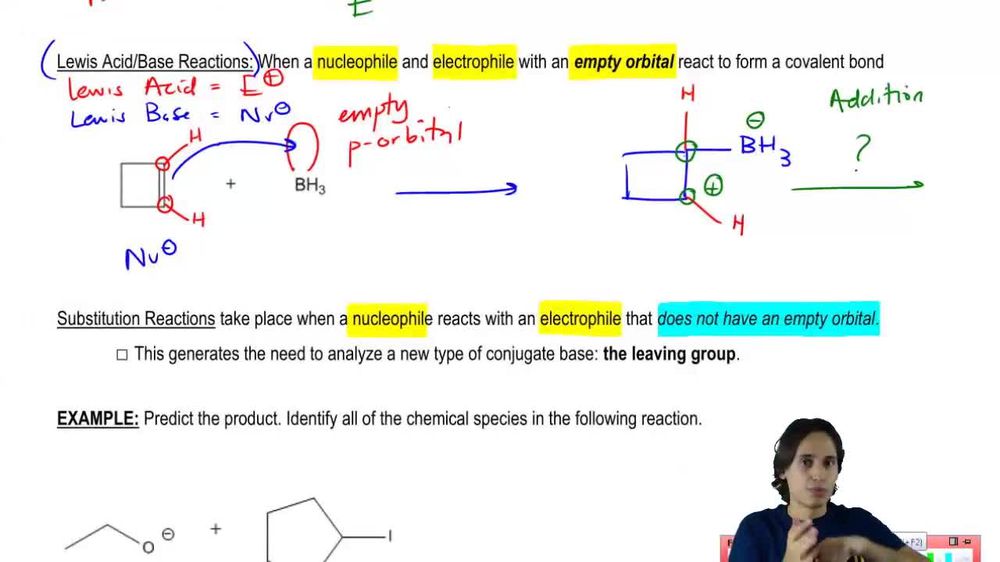
Nucleophiles and Electrophiles can react in Substitution Reactions.
Multistep Synthesis
Multistep synthesis refers to the process of constructing complex organic molecules through a series of sequential reactions. Each step typically involves the transformation of reactants into intermediates and finally into the desired product. Mastery of multistep synthesis is essential for chemists, as it allows for the strategic planning of synthetic routes to achieve specific molecular architectures efficiently.