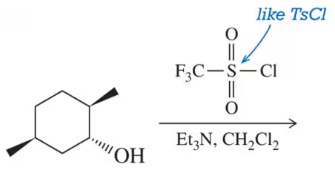
Predict the product of the following sulfonylation reactions. (d)
Verified step by step guidance
1
Identify the functional groups in the starting material. The starting material is a cyclohexanol derivative with an alcohol group (OH) attached to the cyclohexane ring.
Recognize the reagent used in the reaction. The reagent is trifluoromethanesulfonyl chloride (CF3SO2Cl), which is similar to tosyl chloride (TsCl) and is used to convert alcohols into sulfonate esters.
Understand the role of the base, triethylamine (Et3N), in the reaction. The base is used to neutralize the hydrochloric acid (HCl) byproduct formed during the reaction, facilitating the formation of the sulfonate ester.
Predict the mechanism of the reaction. The alcohol oxygen will attack the sulfur atom of the trifluoromethanesulfonyl chloride, displacing the chloride ion and forming a trifluoromethanesulfonate ester.
Consider the stereochemistry of the product. Since the reaction involves the formation of a new bond at the oxygen atom, the stereochemistry at the carbon center attached to the oxygen remains unchanged. The product will be a trifluoromethanesulfonate ester with the same stereochemistry as the starting alcohol.
Verified video answer for a similar problem:
This video solution was recommended by our tutors as helpful for the problem above
Play a video:
0 Comments
Key Concepts
Here are the essential concepts you must grasp in order to answer the question correctly.
Sulfonylation
Sulfonylation is a chemical reaction that introduces a sulfonyl group (SO2) into a molecule. This process typically involves the reaction of a sulfonyl chloride with an organic compound, often an aromatic ring or an alcohol, leading to the formation of sulfonate esters or sulfonamides. Understanding the mechanism of this reaction is crucial for predicting the products formed.
Electrophilic aromatic substitution (EAS) is a fundamental reaction in organic chemistry where an electrophile replaces a hydrogen atom on an aromatic ring. This reaction is essential for understanding how sulfonyl groups can be introduced into aromatic compounds. The stability of the aromatic system and the nature of the substituents influence the regioselectivity of the reaction.
Regioselectivity refers to the preference of a chemical reaction to yield one structural isomer over others when multiple possibilities exist. In the context of sulfonylation, the position where the sulfonyl group attaches to the aromatic ring can vary based on existing substituents and their electronic effects. Recognizing these patterns is vital for accurately predicting the products of the reaction.

 Verified step by step guidance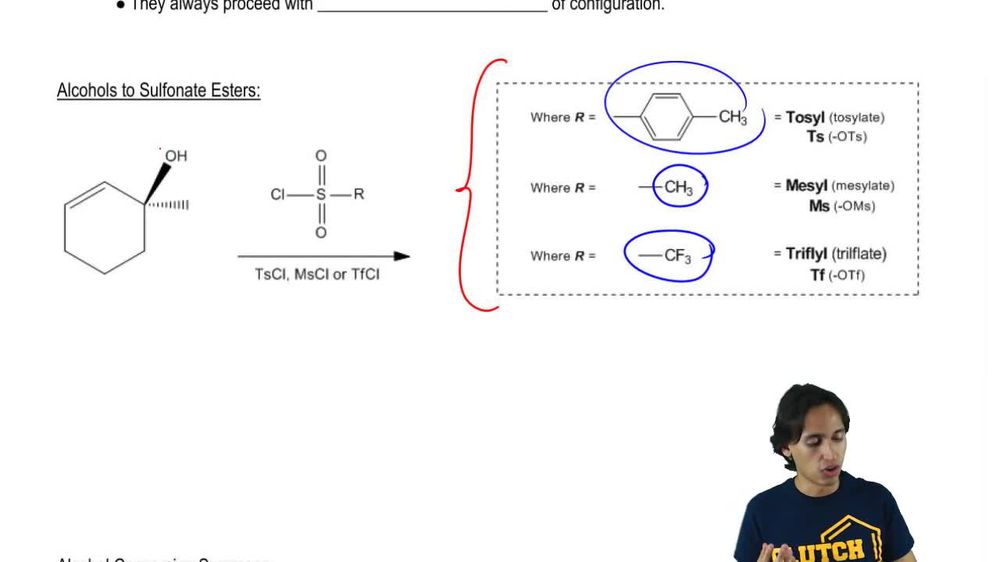
 05:33
05:33