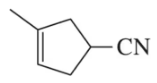
Using an appropriate tosylate intermediate, synthesize the following molecules starting from the appropriate alcohol. (a)
Verified step by step guidance
1
Identify the starting alcohol: The target molecule is a cyclopentane ring with a cyanide group. The starting alcohol should have a similar structure, likely a cyclopentanol with a methyl group at the same position as in the target molecule.
Convert the alcohol to a tosylate: React the alcohol with p-toluenesulfonyl chloride (TsCl) in the presence of a base like pyridine. This will convert the hydroxyl group into a tosylate group, which is a good leaving group.
Perform nucleophilic substitution: Use a cyanide ion (CN⁻) as the nucleophile to perform an SN2 reaction. The tosylate group will leave, and the cyanide ion will replace it, forming the desired nitrile group.
Consider stereochemistry: If the starting alcohol is chiral, ensure that the stereochemistry is retained or inverted as required by the reaction conditions. SN2 reactions typically result in inversion of configuration.
Purify the product: After the reaction, purify the product using techniques such as distillation or recrystallization to obtain the desired nitrile compound in pure form.
Verified video answer for a similar problem:
This video solution was recommended by our tutors as helpful for the problem above
Play a video:
0 Comments
Key Concepts
Here are the essential concepts you must grasp in order to answer the question correctly.
Tosylate Formation
Tosylates are formed by reacting an alcohol with tosyl chloride (TsCl) in the presence of a base. This reaction converts the alcohol into a better leaving group, the tosylate, which facilitates nucleophilic substitution reactions. Understanding this transformation is crucial for synthesizing target molecules from alcohols.
Nucleophilic substitution reactions, such as SN1 and SN2, are fundamental in organic synthesis. In SN2 reactions, a nucleophile attacks the electrophilic carbon, displacing the leaving group in a single concerted step. In contrast, SN1 involves the formation of a carbocation intermediate, followed by nucleophilic attack. Recognizing which mechanism to apply is essential for predicting the outcome of the synthesis.
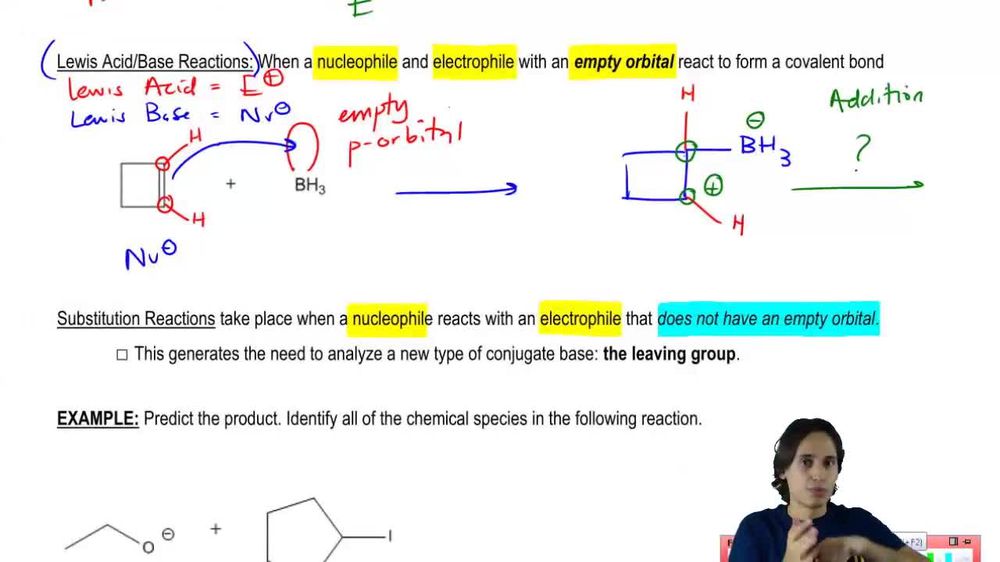
Nucleophiles and Electrophiles can react in Substitution Reactions.
Stereochemistry in Organic Reactions
Stereochemistry refers to the spatial arrangement of atoms in molecules and is critical in organic synthesis. Reactions can lead to different stereoisomers, which can have vastly different properties. When synthesizing molecules, especially those with chiral centers, understanding how to control stereochemistry is vital for achieving the desired product.