Ch.3 - Structure and Stereochemistry of Alkanes
Wade - Organic Chemistry 9th Edition
Wade9th EditionOrganic ChemistryISBN: 9780135213728Not the one you use?Change textbook
Chapter 3, Problem 48g,h

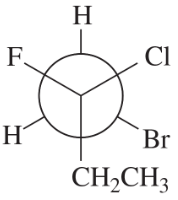
Convert each Newman projection to the equivalent line–angle formula, and assign the IUPAC name. g.
(g)
(h)

Verified step by step guidance
1
Step 1: Analyze the Newman projection for structure (g). The front carbon (closest to the viewer) has three substituents: two hydrogens and one fluorine. The back carbon (farthest from the viewer) has three substituents: three fluorine atoms and a CBr3 group.
Step 2: Convert the Newman projection of structure (g) into a line-angle formula. The front carbon is bonded to two hydrogens and one fluorine, while the back carbon is bonded to three fluorine atoms and a CBr3 group. Arrange these substituents in a tetrahedral geometry around each carbon.
Step 3: Assign the IUPAC name for structure (g). Identify the longest carbon chain and prioritize substituents based on IUPAC rules. The CBr3 group is a trihalogenated substituent, and fluorine atoms are halogen substituents.
Step 4: Analyze the Newman projection for structure (h). The front carbon has three substituents: two hydrogens and one fluorine. The back carbon has three substituents: one ethyl group (CH2CH3), one bromine atom, and one chlorine atom.
Step 5: Convert the Newman projection of structure (h) into a line-angle formula. The front carbon is bonded to two hydrogens and one fluorine, while the back carbon is bonded to an ethyl group, a bromine atom, and a chlorine atom. Assign the IUPAC name by identifying the longest chain and prioritizing substituents based on IUPAC rules.

Verified video answer for a similar problem:

This video solution was recommended by our tutors as helpful for the problem above.
Video duration:
4m
Was this helpful?

Key Concepts

Here are the essential concepts you must grasp in order to answer the question correctly.

Newman Projections

Newman projections are a way to visualize the conformation of a molecule by looking straight down the bond connecting two carbon atoms. This representation helps in understanding the spatial arrangement of substituents around the bond, which is crucial for analyzing steric interactions and torsional strain in organic compounds.
Recommended video:
Guided course
00:34
Introduction to Drawing Newman Projections

Line-Angle Formulas

Line-angle formulas, also known as skeletal structures, are a simplified way to represent organic molecules. In this format, vertices represent carbon atoms, and lines represent bonds, with hydrogen atoms typically omitted for clarity. This method allows for quick visualization of molecular structure and connectivity, making it easier to identify functional groups and overall molecular geometry.
Recommended video:
Guided course
02:46
What is angle strain?

IUPAC Nomenclature

IUPAC nomenclature is a systematic method for naming organic chemical compounds. It provides rules for naming based on the structure of the molecule, including the longest carbon chain, functional groups, and substituents. Understanding these rules is essential for accurately identifying and communicating the identity of organic compounds, especially when converting between different structural representations.
Recommended video:
Guided course
03:43
The different parts of an IUPAC name